
Rock identifier: how to name a rock, crystal, gemstone or meteorite
By the AstroStack team · Updated
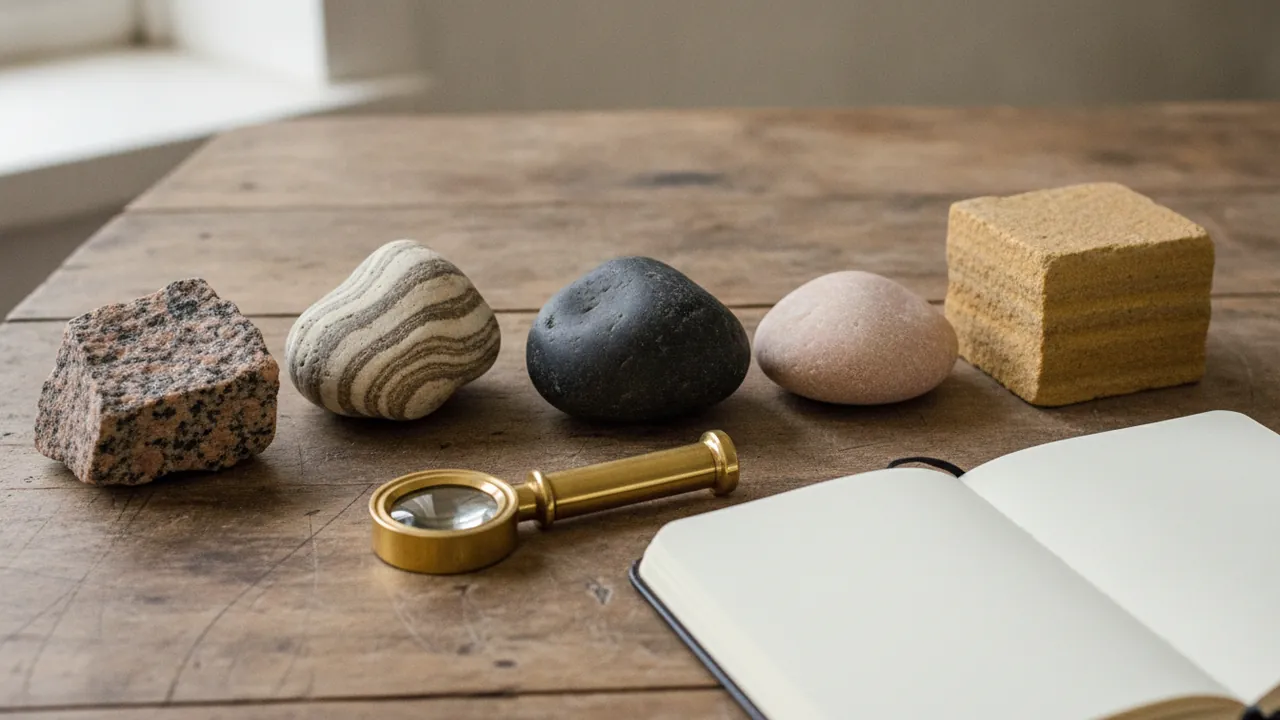
A good rock identifier is not a gadget, it is a short routine: look at a fresh surface, run two or three cheap tests, and note where you found the thing. That is enough to name most rocks, and it also tells you quickly when a find is something stranger, such as a crystal, a meteorite or a piece of natural glass.
Three questions that help name almost any rock
Before you test anything, answer three questions. Is the surface weathered? Break a corner off a rock you are allowed to damage, or look at a fresh crack, because the outside of a stone is often stained or coated and hides what it really is. Is it one material or a mix? A rock made of visible grains of different colors is almost always a rock, while a single uniform material with flat faces or a glassy shine is more likely a mineral. And where was it? A beach, a dry riverbed, a quarry and a volcano's flank each narrow the list before you pick up a magnet.
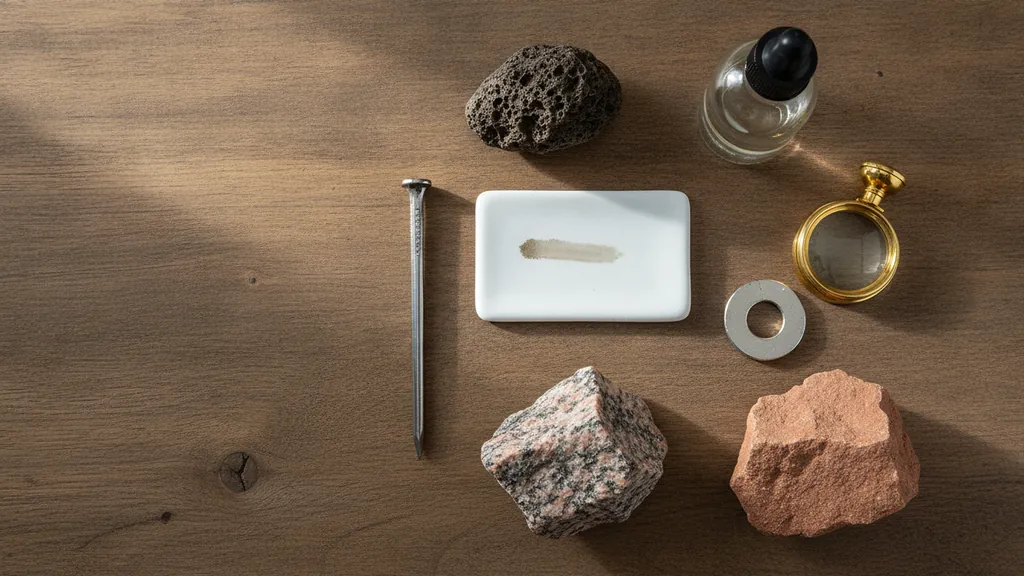
Five kitchen-table tests for rocks and minerals
| Test | How | What it tells you |
|---|---|---|
| Hardness | Try to scratch the stone with a fingernail, a steel nail or a piece of glass | Soft stones (talc, gypsum, calcite) separate from hard ones (quartz and most gems, which scratch glass) |
| Streak | Rub the stone on an unglazed porcelain tile | The powder color. It is often different from the stone itself, and it separates real gold from pyrite |
| Magnet | Hold a magnet near it | A strong pull points to magnetite, or iron meteorite if the stone is heavy and dark |
| Vinegar | Put one drop on a fresh surface | Fizzing means carbonate, such as limestone, marble or calcite |
| Heft and texture | Compare weight with a rock of similar size, and look with a hand lens for grains, crystals or glass | Dense and dark may be metal-rich. Grains in layers suggest sedimentary rock, interlocking crystals igneous, banding metamorphic |
The step-by-step version, with a chart of common rocks, is in our guide on how to identify rocks. Write down the location and take photos in daylight before you start, since a note on where it lay is a clue no test replaces.
Which guide matches the rock or crystal you hold
Crystals, gems and minerals to identify
Identifying a clear or colored stone
Start with the gemstone identifier, which explains what a loupe can and cannot tell you, and why a scratch test is a bad idea on a gem.
Identifying a crystal cluster, point or cube
The crystal identifier covers habit, cleavage and the handful of minerals that make up most crystal shops.
Identifying a clear double-ended crystal
It may be a Herkimer diamond, a quartz crystal from New York that looks cut without any polishing.
Identifying a brown or gray quartz point
Smoky quartz gets its color from natural radiation, and the page explains how to separate it from dyed and treated stones.
Telling gold from pyrite in a yellow fleck
Real gold or pyrite? The tests are set out in how to identify gold in rocks.
Identifying a round, bumpy rock
What is a geode shows how to tell and how to open one safely, and where to find geodes lists real US locations and the rules for each.
Space rocks and meteorites
What a meteorite is
What is a meteorite explains the types, the words meteor and asteroid, and what a space rock is worth.
Is a dark, heavy stone a meteorite?
Most suspected meteorites are ordinary rocks. What does a meteorite look like gives the real tests and the look-alikes that fool people.
Green crystals set in metal
Pallasite explains why olivine sits in a web of iron-nickel metal, and how to check a slice.
Meteorite rings and jewelry
Meteorite rings covers how to tell real iron from etched steel, whether it rusts and what it costs.
Natural glass finds
Black, glassy and sharp-edged? What is obsidian covers volcanic glass, its colors and where you may legally pick it up. Glass can also come from the sky and from lightning. Meteorite glass sorts out which glasses really come from impacts, then points to the deep pages: moldavite, the green glass from the Czech Republic and the most searched of them, tektites from Asia, Australia and North America, and Libyan desert glass from the Sahara. Fulgurite is what lightning makes in sand, and trinitite is the green glass fused by the first atomic bomb test in 1945.
Common rock and mineral mix-ups
| You think it is... | It is often... | Check with |
|---|---|---|
| A diamond | Clear quartz or glass | Hardness: a diamond scratches everything |
| A meteorite | Slag, hematite or basalt | Magnet, streak and a cut corner |
| Gold | Pyrite or mica | Streak and malleability |
| Moldavite | Green bottle glass | Bubbles and wire-like inclusions |
| Smoky quartz | Dyed or irradiated quartz, or brown glass | Hardness and a lab report |
Using a photo or an app to identify a rock
A photo is a fair way to get a shortlist and a poor way to get an answer. The US Geological Survey says rocks and minerals are very hard to identify from photographs, because a camera cannot measure hardness, streak, density or magnetism. If you want a quick first guess anyway, AI Rock ID is a photo-based identifier for crystals, rocks and gemstones, available on the App Store and Google Play, and there is more about it at airockid.com. We compare it with other apps on rock identifier app. Treat any app answer as a candidate name, then confirm it with a streak and a hardness test.
Collecting rules to check before you pick up a find
Rules decide what you can keep as much as science does. Rockhounding for small amounts is generally allowed on much BLM land, but national parks, active mining claims and archaeological sites are not open to collecting, and private land needs the owner's permission. Meteorites, fossils and artifacts each have their own rules, so photograph an unusual find where it lies, note the spot and read the matching page here before you move it.
About the AstroStack rock guide
AstroStack started life as astrophotography software and is now a small field guide. The about page explains that history and how each page is researched.
Frequently asked questions
Is there a free rock identifier?
Yes. The tests in this guide cost nothing, and Rockd, from the University of Wisconsin-Madison, is a free app showing the mapped bedrock under your location.
Can I take a picture of a rock and identify it?
A photo gives a candidate name, not a confirmed one. The US Geological Survey says rocks and minerals are very difficult to identify from photographs and should be examined in person.
Can Google Lens identify rocks?
Google Lens finds visually similar images, so it can suggest names for distinctive rocks. Google publishes no accuracy figure for rocks, and weathered or mixed stones often fool image matching.
How do I identify what kind of rock I have?
Check for layers, crystals and holes. Layers point to sedimentary rock, interlocking crystals or glassy texture to igneous, and aligned bands or flakes to metamorphic.
What should I do if I think I found something rare?
Photograph it where it lies, note the exact location and do not clean or cut it. Meteorites, gold and fossils each have their own rules about who may keep them.
Which Mohs hardness do a fingernail and a steel nail have?
A fingernail scratches materials up to about 2.5 on the Mohs scale, and a steel nail or window glass sits near 5.5. Quartz at 7 scratches both.
Which kitchen-table tests help identify a rock?
Five household tests do most of the work: scratch hardness, streak on unglazed porcelain, a magnet, a drop of vinegar, and heft and texture under a hand lens.
Where is rockhounding allowed in the US?
Rockhounding for small amounts is generally allowed on much BLM land. National parks, active mining claims and archaeological sites are closed to collecting, and private land needs the owner's permission.