
How to identify gold in rocks, and not fool yourself
By the AstroStack team · Updated
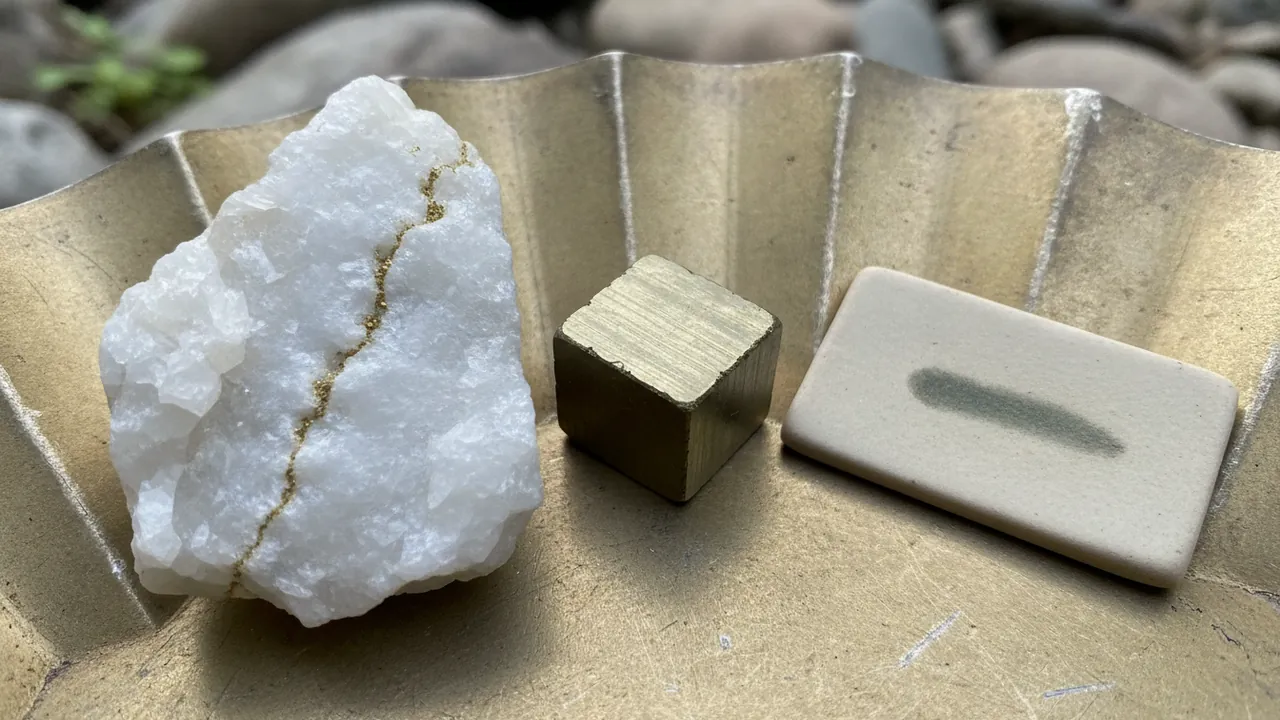
To identify gold in rocks, test the yellow metallic flecks for four things: real gold is soft and dents under a pin, leaves a golden-yellow streak, is very heavy for its size, and stays bent when pressed. Pyrite is hard and brittle with a dark green-black streak, and mica flakes spring back and leave a white streak.
Gold, pyrite and mica compared side by side
| Property | Gold | Pyrite (fool's gold) | Mica |
|---|---|---|---|
| Hardness (Mohs) | 2.5 to 3 | 6 to 6.5 | Typically 2 to 3 |
| Specific gravity | 19.3 for pure gold | About 5 | Depends on the mica; not a useful test |
| Streak | Golden yellow | Dark green to black | White |
| Behavior | Malleable; dents, flattens, stays bent | Brittle; resists a point, chips or powders | Splits into thin sheets that spring back |
| Look | Irregular grains, flakes or nuggets | Sharp cubes or geometric crystals | Thin, reflective sheets |
These values come from the US Geological Survey's page on fool's gold. Gold is nearly four times as dense as pyrite, which is why panning works: gold sinks and stays in the pan while lighter minerals wash out.
Tests for gold in a rock, in the order to run them
- Press a pin or knife point into the flake. Gold dents or gouges. Pyrite resists and may chip or powder.
- Scratch or rub it on unglazed porcelain. Golden yellow is gold, dark green-black is pyrite, and a white mark is mica.
- Tilt it under a lamp. Gold keeps the same yellow in every direction. Pyrite and mica flash on and off as you turn them, because the flakes catch light at angles.
- Bend or press a loose flake. Gold stays deformed, and mica springs back.
- Pan a crushed sample if you can. Heavy yellow grains left in the pan are promising, while mica and pyrite wash away more easily.
Gold is not magnetic, so a magnet does not help here. The wider hardness and streak steps are described in how to identify rocks, and the cubic habit of pyrite is covered in the crystal identifier.
Chalcopyrite, biotite and other minerals mistaken for gold
Pyrite gets all the attention, but chalcopyrite is another brassy yellow sulfide. It is softer than pyrite, with a greenish-black streak, and it tarnishes to iridescent colors. Weathered, rusty-brown pyrite grains can also look like dull gold in a pan. Biotite mica, the dark kind, can look bronze when it catches the sun, and golden mica flakes in sand are the classic false alarm in a stream. When a yellow flash disappears as you tilt the sample, it was mica.
Gold in the real world usually sits in quartz veins or in stream gravel. It shows as tiny specks, not nuggets, and you may need the hand lens from the basic kit to see it. A heavy rock with no visible gold is more likely iron-rich than gold-rich.
Why visible yellow flecks do not prove gold
USGS notes that gold in lode rock may not be visible and that confirmation depends on laboratory analysis. If a rock matters, send a representative sample of about 3 to 5 pounds to a commercial assay laboratory. The report gives gold content, usually in troy ounces per short ton or grams per metric ton. Without an assay, the gold content of a specimen is unknown, and a gold-colored mineral can be pyrite or something else. Gold-colored rims inside geodes are usually paint or iron staining, as noted on what is a geode.
Can you keep gold you find in a rock or stream?
It depends on the land.
- BLM land open to mineral entry generally allows recreational panning with hand tools and little surface disturbance, with no special federal permit for casual panning. Sluicing, dredging or machines may need permits, and states may add their own rules.
- National forests mostly allow low-impact panning and prospecting without authorization, but some require a letter, and larger disturbance triggers a notice or plan.
- National parks prohibit prospecting and removing gold.
- On a mining claim, gold belongs to the claimholder. Check BLM and county records first.
- On private land you need the owner's permission, and mineral rights may belong to someone else.
There is no single nationwide panning permit, so call the BLM field office or Forest Service district before you go. For a quick first look at an odd specimen, see the reference entries at rockidentifier.io, and for the whole kit of tests, go to the rock identifier home page.
Frequently asked questions
Is it illegal to find gold and keep it?
Usually not, but it depends on the land. Recreational panning is generally allowed on open BLM land and many national forests, and prohibited in national parks.
How do I tell if a rock has gold in it?
Visible yellow flecks are only a clue, so test them for softness, a golden-yellow streak and malleability. For certainty, the USGS recommends a lab assay of a 3 to 5 pound sample.
Does gold stick to a magnet?
Gold does not stick to a magnet because it is not magnetic. A yellow flake a magnet picks up is not gold, but one that stays put could still be pyrite or mica.
Do I need a permit to pan for gold?
Casual panning with hand tools usually needs no permit on open BLM land or in most national forests. Sluices, dredges and machines can need permits, and states add their own rules.
How can I tell gold from mica?
Press a flake. Gold dents and stays bent, while mica springs back and splits into thin sheets. Mica also leaves a white streak and flashes on and off as you turn it.
How can I tell gold from pyrite?
Pyrite is hard and brittle, leaves a dark green-black streak and forms sharp cubes. Gold is soft, dents under a pin and leaves a golden-yellow streak.