
Tektite: natural impact glass, fields, shapes and prices
By the AstroStack team · Updated
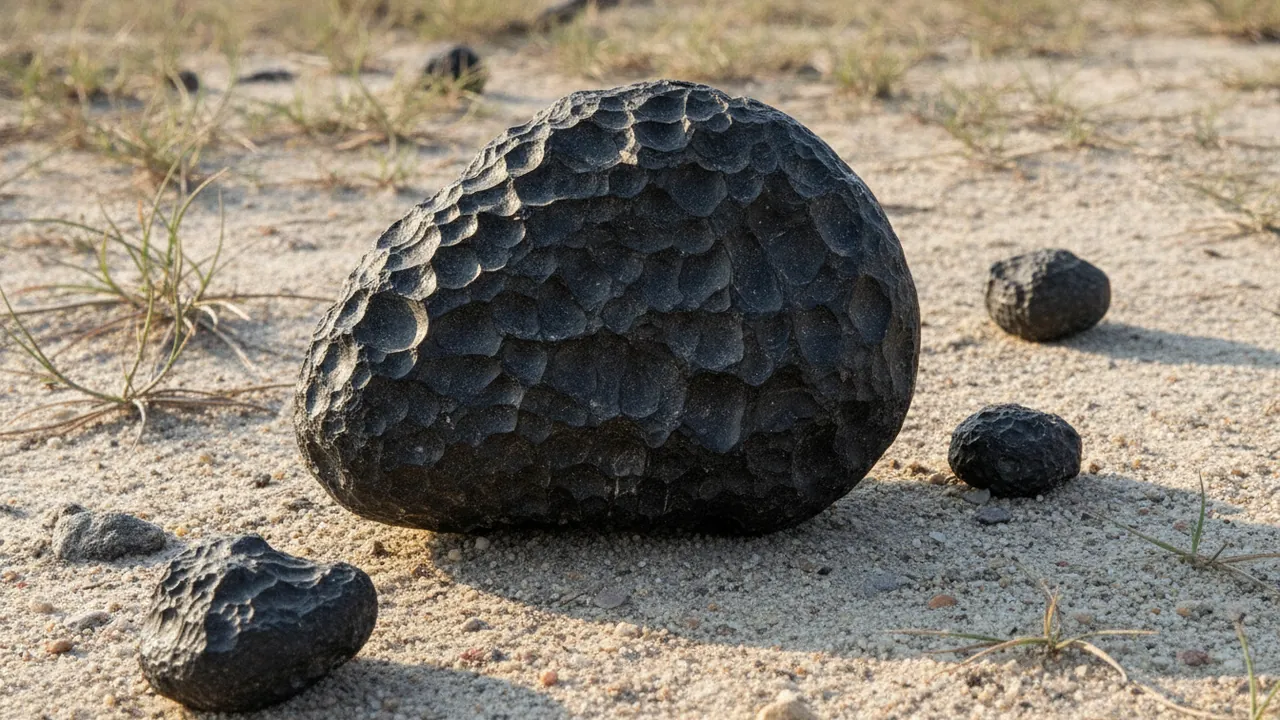
A tektite is a piece of natural glass formed when an asteroid or comet impact melted Earth surface rock and flung the melt into the air, where it cooled in flight and fell back as small glassy pieces. Tektites are not meteorites. They are terrestrial material, and they turn up in four large scattered areas called strewn fields. The name comes from the Greek tektos, meaning molten.
The four strewn fields
| Field | Age | Where | Colors and names | Source crater |
|---|---|---|---|---|
| Australasian | About 0.79 million years | Southeast Asia, southern China, the Philippines, Australia, Tasmania, Indian Ocean sediments | Black, dark brown, olive-green; indochinites, rizalites, australites | Not found |
| Central European | About 14.7 million years | Czech Republic, with some in adjacent Germany and Austria | Green, yellow-green, brown; moldavites | Ries, Germany, about 24 km |
| Ivory Coast | About 1.07 million years | Cote d'Ivoire | Dark brown to black | Bosumtwi, Ghana, about 10.5 km |
| North American | About 35.2 to 35.8 million years | Georgia, Texas, Chesapeake Bay region | Black, dark gray, brown, olive; georgiaites, bediasites | Chesapeake Bay, about 85 km, attribution described as likely, not certain |
The Australasian field is the biggest, with a weighted argon dating of 788,000 years, and its crater remains unknown. That is a real gap in the record, and any seller who names a crater for indochinites is guessing. Darwin glass from western Tasmania, about 816,000 years old, is tied to the small Darwin crater and is usually classed as impact glass of its own rather than a tektite.
What tektites look like
Tektites hold roughly 70 to 80 percent silica and almost no water, with a commonly cited upper limit of 0.03 percent by weight. Hardness is about 5.5 to 6.5 on the Mohs scale, so a steel knife only just scratches one. Sizes run from microscopic grains to about 10 cm. Shapes come from spinning while molten: spheres, ellipsoids, teardrops, dumbbells and buttons are common, and the surface is pitted or grooved by flight and later etching.
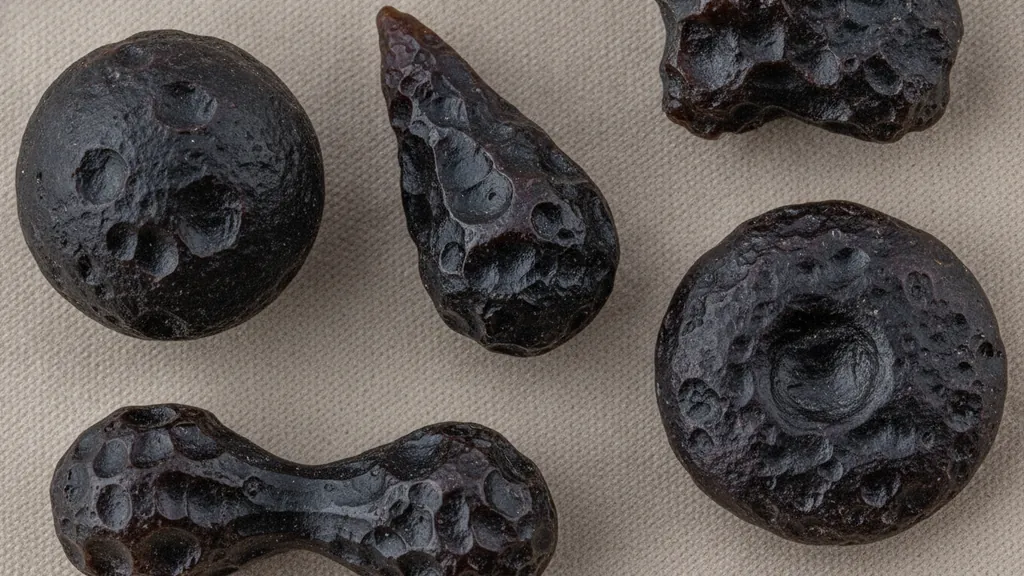
Two other kinds are worth knowing. Muong Nong tektites are bigger, layered and irregular, found mainly in Southeast Asia, and they look more like chunks of glassy rock than aerodynamic drops. Microtektites are grains smaller than a millimeter that settle in deep-sea sediment far from any land, and scientists use them to map each field's edge. The most famous green ones are moldavite, and the most common dark ones are Southeast Asian.
How a tektite forms
- A large impactor hits the ground at high speed and melts the surface rock and sediment at the target.
- The melt is thrown out of the crater in blobs, some for hundreds or thousands of kilometers.
- The blobs spin and stretch as they fly, giving the round, drop and dumbbell shapes.
- They cool into glass before landing and later lose or gain surface detail through weathering.
Because they are made of target rock, tektite chemistry reflects the ground that was hit. The tektites of the North American field match sediments from the eastern United States, for instance. Several lines of evidence tie each field to a crater, though the Australasian one remains unlocated.
Tektite versus obsidian and other look-alikes
Obsidian is also black glass, but it forms in volcanoes and is found near them. Tektites are found in strewn fields with no volcano, often thousands of kilometers from the crater. Obsidian usually has flow banding and larger bubbles, and it holds more water: heated, it can froth, where a tektite generally does not. Tektites often contain lechatelierite, silica glass made from melted quartz, which volcanic glass rarely does. The water test is a lab test, not a field one, so in the field rely on setting and shape. To rule out slag and bottle glass, look for natural wear: shallow pits and etching on tektites, versus mold lines or perfect uniformity on glass. For the bigger comparison, the meteorite glass guide covers every impact glass.
| Clue | Tektite | Obsidian | Bottle glass |
|---|---|---|---|
| Setting | Strewn field, no volcano nearby | Volcanic terrain | Anywhere people have been |
| Shape | Aerodynamic: sphere, teardrop, dumbbell, button | Angular chunks and flakes | Rounded by tumbling, or molded |
| Surface | Pitted, grooved, etched | Smooth, shiny fracture | Frosted on a beach, seams if molded |
| Water content | Almost none | Up to about 1 percent | Varies |
| Bubbles | Few, irregular, with lechatelierite | Banding and some gas bubbles | Round, uniform |
Are tektites radioactive or do they glow?
No more than any other glass. Tektites are not intrinsically radioactive the way uranium-rich minerals are, and they are not known to fluoresce strongly under ultraviolet light. If a piece gives an unusual reading, suspect attached minerals or contamination. UV and radiation tests are not identification tools for tektites, so do not let a seller use them as proof.
Tektite prices, checked November 2026
| Type | Example asking prices | Source and date |
|---|---|---|
| Indochinite | $5 to $14 for pieces of 15.7 to 47.1 g, about $0.30 to $0.36 per gram | Aerolite Meteorites, updated November 9, 2026 |
| Philippine rizalite | 12.90 g for $52; 116 g for $349 (about $3 to $4 per gram) | Higher Level Creations, November 21, 2026 |
| Darwin glass | $25 to $30 for pieces of 4.6 to 5.6 g | Aerolite Meteorites, updated November 9, 2026 |
| Moldavite | About $8 to $174 per gram depending on grade | See the moldavite price table above |
These are dealer asking prices, not appraisals. Condition, shape and provenance move prices, and a clean teardrop sells for more than a chip. Southeast Asian tektites are common, so a high price for a plain black piece needs a reason, such as a perfect shape or documented locality.
What to ask a seller when buying a tektite
- The locality and the type name (indochinite, rizalite, australite, georgiaite, bediasite, moldavite).
- Whether the surface is natural or has been cleaned, etched or polished.
- The weight, so you can compare per-gram price with the table above.
- Returns, in case a lab disagrees.
Healing claims have no scientific support, as explained on the crystal identifier page.
How and where to find a tektite
Tektites are picked up from the surface or from soil in strewn-field areas, often by locals. Rules differ by country and land type, and public land in the US generally restricts collecting, so check before you dig. A find that does not match these traits may be something else, and the rock identification steps are a good second pass. Glass made by lightning or an atomic blast is a different story, covered in fulgurite and trinitite. The rock identifier home page has the rest.
Frequently asked questions
What is the difference between a meteorite and a tektite?
A meteorite is rock or metal from space that survives landing. A tektite is Earth rock melted by an impact and thrown out as glass, so it is not extraterrestrial.
Is Libyan desert glass a tektite?
Not usually. Many researchers link Libyan desert glass to an impact, but it is not counted among the four tektite strewn fields, and its origin is still debated.
How expensive is a tektite?
Common tektites are cheap. In November 2026, dealers listed Indochinites at roughly 30 to 36 cents a gram and Philippine rizalites at about $3 to $4 a gram.
Where are tektites found?
Tektites lie in four strewn fields: Australasia, Central Europe (mostly the Czech Republic), the Ivory Coast, and North America, including Georgia and Texas.
How do I tell a tektite from obsidian?
Location is the first clue, since tektites lie in strewn fields away from volcanoes and obsidian sits in volcanic regions. Tektites also have flight-shaped forms and very low water content.
Are tektites radioactive?
No. Tektites are glass from melted surface rock and are not intrinsically radioactive like uranium minerals. A strange reading usually comes from attached minerals or contamination.
What are the four tektite strewn fields?
The four recognized strewn fields are Australasian, Central European, Ivory Coast and North American. The Australasian field is the largest and its source crater has never been found.