
Fulgurite: how lightning turns sand into glass
By the AstroStack team · Updated
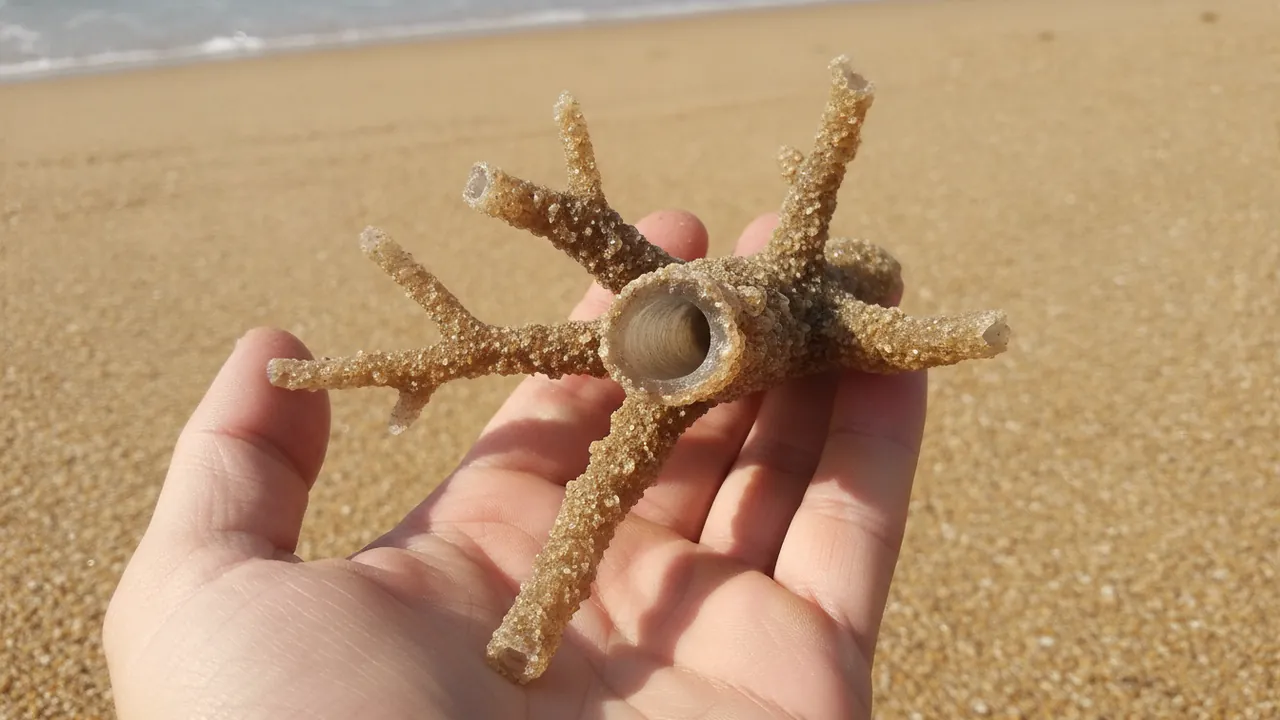
Fulgurite is natural glass formed when a cloud-to-ground lightning strike melts sand, soil or rock and the melt cools almost instantly. In sand it makes a hollow, branching tube with a rough outer coating of sand grains and a smooth glassy bore, and it is one of the few natural glasses that has nothing to do with volcanoes or impacts. The word comes from the Latin fulgur, lightning, and people also call the tubes "petrified lightning".
How lightning makes a fulgurite
Melting quartz sand takes about 1,800 degrees Celsius (roughly 3,270 degrees Fahrenheit), and lightning channels can be far hotter: values above 30,000 kelvin are cited for the air in the channel. The sand does not reach that temperature everywhere, because the discharge lasts a fraction of a second. The fused material is mainly silica glass (lechatelierite) mixed with unmelted grains, and the narrow melt path cools fast enough to freeze into a tube along the lightning channel, with gas blown outward by the heat leaving the hollow bore.
Most strikes make nothing. A fulgurite needs loose, dry, silica-rich ground and a current path that dumps enough energy into it, which is why they are found in dunes, beaches, desert margins and sand pits, and rarely in wet soil.
Sand, soil and rock fulgurites
- Sand fulgurites form in clean, dry quartz sand on beaches, dunes, lake shores and deserts. These are the tubes people collect.
- Soil or clay fulgurites form in silt, clay or gravel and can be lumpy, bubbly or slag-like, so they are harder to recognize.
- Rock fulgurites are glassy crusts, veins or channels on exposed rock, especially mountain summits.
Mindat uses four types (sand, clay, caliche and rock), and some researchers add more for unusual targets, so the three-way split here is a simplification.
How big and how deep fulgurites grow
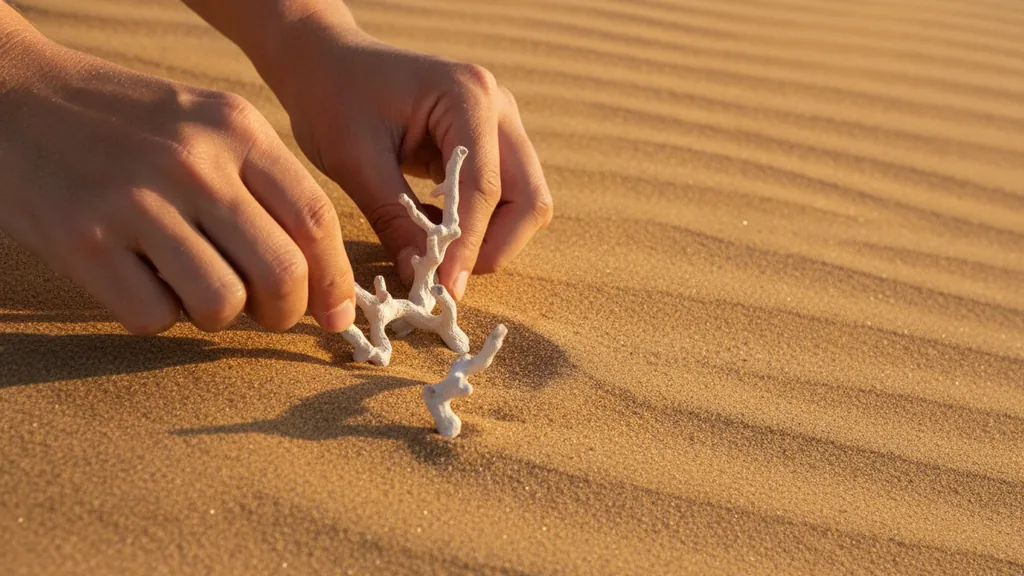
Sand fulgurites are commonly 1 to several centimeters across, and many sources describe them as under 3 meters long. Britannica reports lengths up to 20 meters (66 feet). A northern Florida specimen dug near Camp Blanding in 1996 had branches of more than 4.3, 4.9 and about 2.4 meters. Some run as deep as about 15 meters (49 feet) below the surface. Britannica names Atlantic beaches, the Lake Michigan shore, Toluca in Mexico and Mount Thielsen in Oregon as settings. They are fragile, with thin walls that break during digging, so big specimens usually come out in pieces.
Why scientists study fulgurites
Fulgurites record what lightning does to the ground, and they hold lechatelierite, the same silica glass that appears in impact glasses. That overlap is why lightning was proposed as one explanation for Libyan desert glass, an idea most researchers have set aside in favor of an impact or airburst; the Libyan desert glass page explains the debate. A fulgurite from the Libyan Desert was dated by thermoluminescence to about 15,000 years, and gas trapped in it points to a wetter, Sahel-like climate at the time. Matthew Pasek and colleagues at the University of South Florida have also studied the odd phosphorus chemistry that lightning produces in these glasses, which matters to ideas about how reactive phosphorus reached the early Earth.
The only other famous glass made by an instant of extreme heat on the ground is trinitite, fused by the first atomic test.
How to tell if fulgurite is real
- The tube is hollow or partly hollow, narrow and irregular, with walls of uneven thickness.
- The outside is rough and sandy, partly unfused grains.
- Broken ends show a smooth, glassy, fused interior, sometimes with small blister-like bubbles.
- Branches taper and look root-like, following a lightning channel, not a uniform manufactured shape.
- It is very light and fragile, unlike dense solid glass.
A perfectly uniform, clear tube with a constant diameter is suspicious, because that is what a furnace makes. Color does not prove anything. Looking like glass is not enough either: fulgurites can be confused with other tubes and slag, and a magnet does not settle it. Locality and provenance matter, and a mineralogist or lab can check for lechatelierite, relict quartz and the other textures that lightning leaves. If you are looking at other glassy finds, the meteorite glass guide separates impact glass from lightning glass, and obsidian covers the volcanic kind.
Fulgurite compared with root casts, slag and trinitite
| Find | How it formed | How to tell it apart |
|---|---|---|
| Fulgurite | Lightning melts sand or soil | Hollow branching tube, sandy outside, glassy bore |
| Root cast or concretion | Minerals cement sand around a root | Not glassy; breaks like cemented sand, dull inside |
| Slag or furnace glass | Industrial melting | Even thickness, dense, often near old kilns or roads |
| Trinitite | Nuclear blast fused desert sand | Flat green glass, not a tube |
How to dig up and store a fragile fulgurite
If you find a tube, assume it will break. Walls are thin, branches snap, and large specimens often come out in fragments. Dig around it, not at it, keep the soil with it where you can, and carry it in a rigid box padded with paper or foam. Support long branches from underneath. Do not scrub, sand or polish it, and keep it out of ultrasonic cleaners and acids. A soft brush, an air blower or a gentle rinse is plenty, because sand grains on the outside are part of the specimen. Dry it fully before storing, and keep it in a padded container away from knocks.
Fulgurite prices, checked November 2026
Retail asking prices for sand fulgurites fell in these bands in listings seen on November 22, 2026. A 1 g piece was $30. A 4.7 g piece was $65, and another $90. A 14 g piece was $140, and a 16 g piece was $190 (about $10 to $12 per gram). A 3.7 g thin "straw" was $90. A large 7.5-inch specimen was $310 per piece. Per-gram prices therefore run from about $10 for bigger pieces to about $30 to $65 for tiny ones, with outliers near $100. These are asking prices, not sales, and intact length, branching and locality all matter. A long, unbroken tube with several branches is worth far more than the same weight in fragments.
Is it legal to collect fulgurite?
There is no single US rule. The National Park Service asks visitors to leave fulgurites in place at Great Sand Dunes National Park, and Monahans Sandhills State Park in Texas tells visitors to study them and leave them in the dunes. On other public land, rules depend on the managing agency, so check with them first. On private land you need the owner's permission. Buying and owning fulgurite is legal.
If you find a glassy tube and are unsure, start with the rock identification steps, or go back to the rock identifier page for everything else.
Frequently asked questions
What happens when lightning hits sand?
Lightning heats the sand past about 1,800 degrees Celsius and melts the silica. The melt freezes in a split second into a hollow glass tube called a fulgurite.
Are fulgurites worth money?
Small sand fulgurites sold for roughly $30 to $65 per gram in November 2026 listings, and larger ones about $10 to $12 per gram. Intact branching pieces fetch more than fragments.
How rare is fulgurite?
Intact fulgurites are hard to find because they are buried, fragile and often broken by digging. Most strikes on wet or solid ground leave no glass at all.
Is it legal to collect fulgurite?
Legality depends on the land. National parks ask visitors to leave fulgurites, Monahans Sandhills State Park in Texas says to leave them in the dunes, and private land needs the owner's permission.
How can I tell real fulgurite from a fake?
Real sand fulgurite is a fragile, hollow, branching tube with a sandy outside and a smooth glassy bore. A perfectly even, dense, solid tube suggests a manufactured piece.
How deep are fulgurites buried?
Most sit in the top meter or so of sand, but reports describe some running about 15 meters (49 feet) down. The tube follows the lightning channel and branches as it goes.
What are the types of fulgurite?
Sand fulgurites form in clean quartz sand, soil or clay fulgurites in silt and gravel, and rock fulgurites as glassy crusts on exposed rock. Mindat lists four types, adding caliche.