
Moldavite: green impact glass and how to tell real from fake
By the AstroStack team · Updated
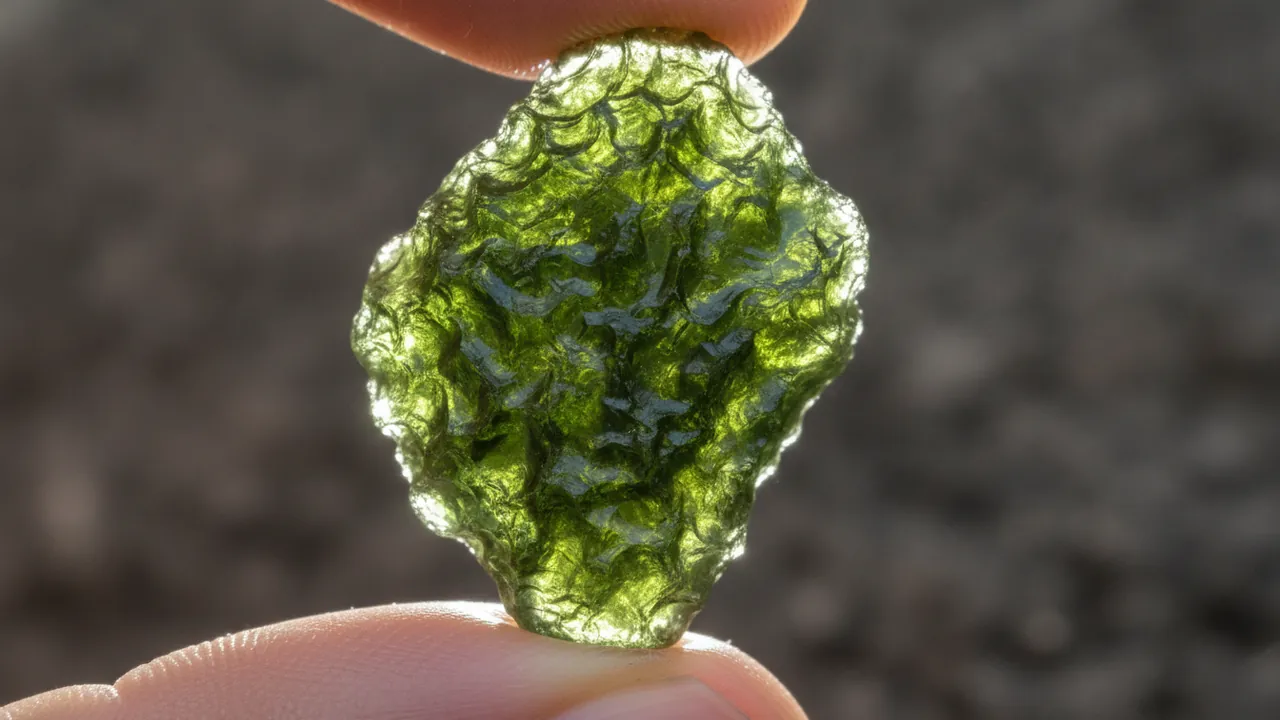
Moldavite is a green natural glass, a kind of tektite, found in the Czech Republic and formed when the Ries meteorite impact in southern Germany melted rock about 15 million years ago. It is not a meteorite and not a crystal. It is glass, and a lot of what is sold as moldavite is not even that. This page covers where it comes from, how to tell if moldavite is real, what it should cost and how to look after it.
Where moldavite comes from
The Nordlinger Ries is a crater about 24 km across near Nordlingen in Bavaria. The impact threw molten Earth material east, and it fell as glass across what is now southern Bohemia and Moravia in the Czech Republic, with a few pieces in neighboring Austria and Germany. Mindat gives the age as approximately 15 million years, and GIA and the tektite literature put the Central European strewn field at 14.7 million. Unlike the huge Australasian field, whose crater has never been found, this one has a known source. For the other fields, see tektites.
The classic localities are in South Bohemia, with Besednice in the Cesky Krumlov District the best known. GIA notes that Besednice pieces show the deepest "heat-sculptured" surfaces and are often kept as specimens rather than cut. Moravia, around Dukovany, Znojmo and Trebic, is the second main area. Moldavite is named after the Moldau, the German name for the Vltava river, which runs through the same region.
It is also an old gem. GIA records moldavite at the Venus of Willendorf site in Austria, in a context about 29,000 years old, and faceted moldavite became fashionable in Czech jewelry in the second half of the nineteenth century, often set with Czech garnets.
What moldavite is made of
Like other tektites it is about 70 to 80 percent silica and almost free of water. It measures roughly 5.5 to 6.5 on the Mohs scale, a range close to window glass, so it scratches and chips more easily than quartz. Natural color runs from light green to olive, grayish green and green-brown. Very dark pieces look nearly black until you hold them to a lamp.
| Property | Natural moldavite (GIA) | "Chinese moldavite" imitation (GIA) |
|---|---|---|
| Density | 2.35 typical, 2.27 to 2.46 | 2.52 to 2.53 |
| Refractive index | 1.490 typical, 1.480 to 1.510 | 1.520 |
| UV fluorescence | Inert under long-wave and short-wave | Chalky glow under short-wave in some |
| Inside the glass | Lechatelierite wires, irregular stretched bubbles, swirls | Round bubbles, uniform glass |
Those numbers need a gem lab or at least a refractometer and a scale, but they are the reason a lab report is worth paying for on an expensive piece.
What real moldavite looks like
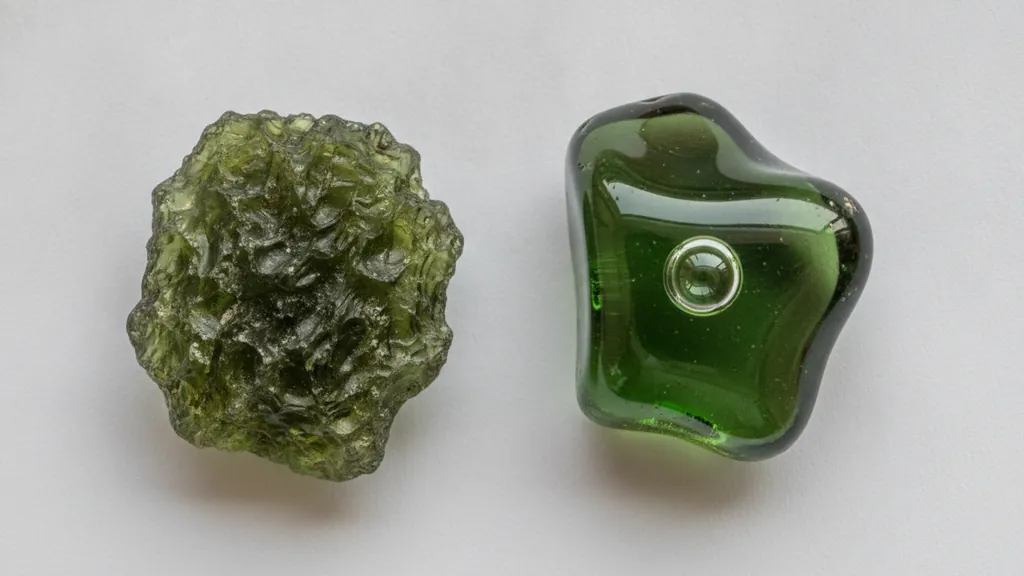
Natural rough moldavite is translucent and covered in wrinkles, ridges, pits, spires and grooves that look sculpted by water. The pattern comes from a hot, spinning glass blob cooling in flight and then being etched by acids in the soil over millions of years. Color alone proves nothing, since real stones range widely, and the surface alone proves nothing either: GIA notes that nearly identical artificial etching can be made chemically. Inside is where the proof is.
How to tell if moldavite is real
- Look for lechatelierite. This is silica glass melted at very high temperature, and it shows up as thin, wavy, wire-like inclusions. GIA calls these wires easy to see with a loupe because their refractive index differs from the surrounding glass.
- Check the bubbles. Natural bubbles are irregular, stretched and unevenly spread. Perfectly round bubbles of the same size suggest manufactured glass.
- Look for flow structure. Real moldavite shows wispy, chaotic swirls (schlieren). Repeating, evenly distributed swirls are suspicious.
- Immerse rough stones in water, or better in oil with a similar refractive index. GIA recommends this because it makes lechatelierite wires easier to see.
- Inspect polished stones inside, since cutting removes the sculpture. For these, lechatelierite plus refractive index is the strongest practical pair.
- Check for mold seams and repeating texture. The most common fake is molded green bottle glass, and factory glass is sold as "Chinese moldavite".
- If you own a UV lamp, shine it on the stone. Natural moldavite stays dark under both wavelengths, and a chalky glow under short-wave light points to an imitation.
No loupe checklist is decisive on every stone. Lab tests (density, refractive index, spectrum, fluorescence) separate genuine moldavite from imitations, and a polished or unusually clean piece is the best candidate for lab testing. If the seller will not state the locality or take returns, that tells you something too. When you are comparing a piece against other green stones, the gemstone identifier explains what a loupe can add.
The fake moldavite you will actually meet
- Molded bottle or art glass, sold as rough "moldavite" with a fake wrinkled surface. Check for seams and bubbles.
- Acid-etched glass, where the surface looks right and the inside does not.
- Faceted green glass sold as cut moldavite. It is clean and bubble-free, and the density is too high.
Moldavite prices, checked November 2026
| Grade or form | Asking price | Source and date |
|---|---|---|
| Chips and plain rough | About $15 to $25 per gram | Moldavite Gems, October 2026 |
| Common genuine material | About $8 to $20 per gram | WorthMyRock, 2026 guide |
| Regular quality rough | About $26 to $60 per gram | Moldavite Gems, October 2026 |
| Small rough pieces | 1.83 g for $65.88; 4.60 g for $128.80 (about $28 to $36 per gram) | Moldavite Family, November 2026 |
| Etched or disk-shaped rough | About $40 to $75 per gram | Moldavite Gems, October 2026 |
| Museum or rare locality material | About $55 to $174 per gram | Moldavite Gems, October 2026 |
| Faceted stones | About $50 to $300 or more per stone | WorthMyRock, 2026 guide |
All of these are retail asking prices from sellers, not sale prices, and size, clarity, shape and locality move them. A sub-$5 gram price for "genuine" rough is a warning sign. Sculpture counts for more than weight: a small, deeply carved Besednice piece can outsell a larger smooth one.
Why moldavite costs so much
Moldavite comes from a small area, and mining there is regulated. Commercial extraction needs authorization, and illegal digging in South Bohemia has been reported. Supply is limited, and demand from collectors and the crystal market is high. Because it is found as loose pieces in sand and gravel rather than in a vein, no one can scale production up.
Moldavite versus the stones it gets confused with
| Material | What it is | Clues that separate it |
|---|---|---|
| Moldavite | Natural impact glass, about 70 to 80 percent silica | Sculpted surface when rough; lechatelierite wires and irregular bubbles inside; olive to forest green |
| Green bottle glass | Man-made glass | Round bubbles, mold seams, repeating texture, no lechatelierite |
| Peridot | A crystal (olivine) | Crystalline, not glassy; usually faceted and yellow-green; forms in pallasites too, see pallasite |
| Libyan desert glass | Natural impact glass from Egypt | Pale yellow, not green; far higher silica; see Libyan desert glass |
| Obsidian | Volcanic glass | Black or brown, volcanic setting, flow banding; see obsidian |
Questions to ask a seller before you buy moldavite
- Which locality is it from? Moldavite sellers know the Czech finds by area, and a vague answer is a poor sign.
- Can I see the actual piece in strong light, from several angles, not a catalog photo?
- What is the weight, so that I can work out the price per gram against the table above?
- What happens if a lab says it is glass? A seller who offers returns is more likely to be selling the real thing.
Treat sculptured shape as a good first sign, because the first glance is where most fakes fail. The wrinkles on a real piece wander and vary, while molded copies repeat.
How to clean and store moldavite
It is glass, so treat it like a good piece of glass. Clean it with lukewarm water, mild soap and a soft brush, then dry it. Skip ultrasonic and steam cleaners, which can open fine cracks, and keep it away from hot water, hairdryers and sudden temperature swings. Store it apart from harder stones such as quartz and sapphire, because they scratch it, and wrap thin sculpted spires, which snap easily. Etched rough pieces hold dirt in their pits, and a soft toothbrush gets it out.
Do moldavite healing claims hold up?
Sellers often attach spiritual claims to moldavite. There is no scientific evidence that crystals or glass do anything beyond a placebo effect, as covered on the crystal identifier page. If you like the look and the story, that is a fine reason to buy, so long as you are buying real glass.
Compared with other impact glass
Moldavite is one of several natural impact glasses. The meteorite glass overview compares it with Libyan desert glass, fulgurite and obsidian, and crystalidentifier.net has crystal-shop references if you want to check other green stones. Lightning makes its own glass too, which is how fulgurite and trinitite fit into the picture. Back at the rock identifier hub, every other guide is one click away.
Frequently asked questions
How can you tell if moldavite is real?
Real moldavite shows irregular bubbles, flow swirls and thin wavy lechatelierite wires under a loupe, ideally with the rough stone in water or oil. Molded bottle glass has round bubbles and mold seams.
Why is moldavite so expensive?
Moldavite forms in a small part of the Czech Republic, mining there is regulated, and collectors and crystal buyers both want it. Dealers asked about $8 to $174 per gram in late 2026.
What are the healing powers of moldavite?
No scientific evidence supports healing powers in moldavite. In a 2001 experiment, volunteers holding real and fake quartz reported the same sensations, which points to placebo and expectation.
Is moldavite a meteorite?
No. Moldavite is a tektite, glass melted from Earth rock by the Ries impact in Germany about 15 million years ago. The impacting meteorite itself was destroyed.
Where should I buy genuine moldavite?
Buy moldavite from sellers who state the locality, show clear photos or video of the actual piece and offer returns. A price far below dealer averages is a warning.
Does moldavite glow under UV light?
Natural moldavite is inert, so it does not glow under long-wave or short-wave ultraviolet light, according to GIA. A chalky glow under short-wave UV points to an imitation.
How old is moldavite?
Moldavite is about 14.7 million years old, dating from the Ries impact near Nordlingen in Bavaria, according to GIA and the tektite literature.