
Meteorite glass: what it is and which kinds are real
By the AstroStack team · Updated
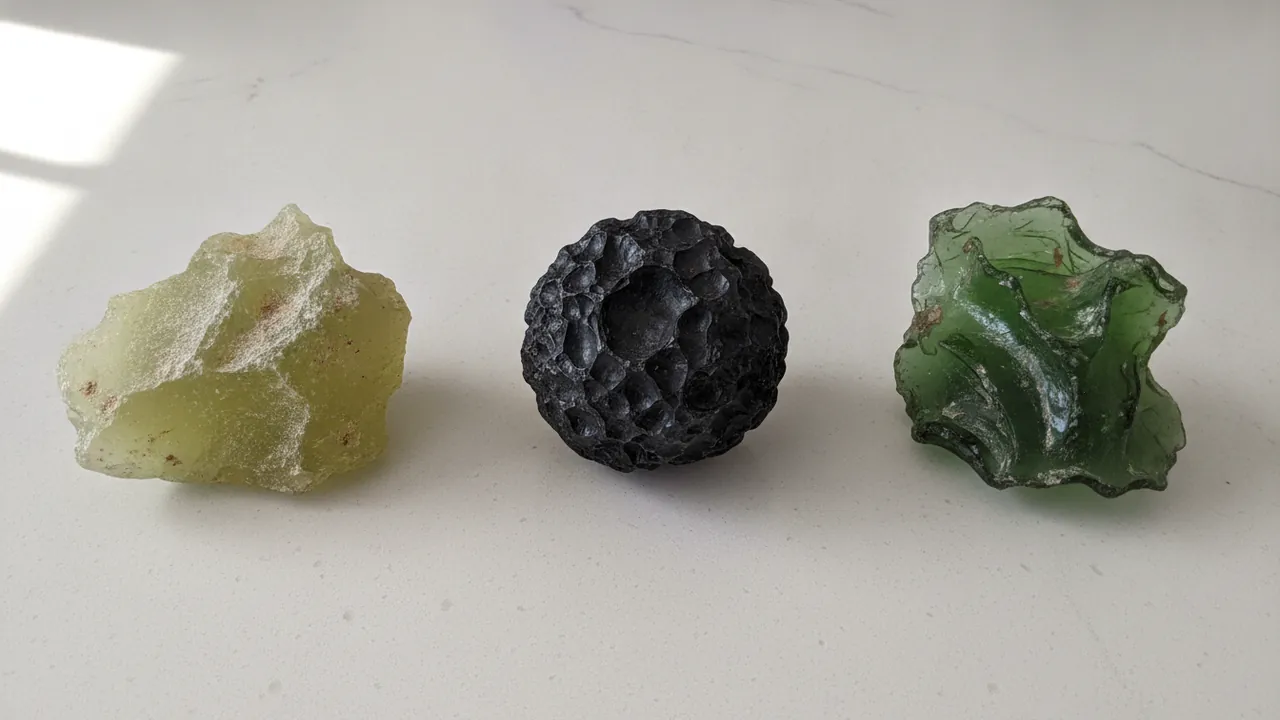
Meteorite glass is the popular name for natural glass linked to meteorite impacts, but it is not made of meteorite. When a large body hits the ground, it melts Earth rock, and the melt cools into glass, so tektites, moldavite and Libyan desert glass are all terrestrial material with an impact history. That separates them from true meteorites, which are described in what a meteorite looks like.
The families of meteorite glass, side by side
| Glass | How it formed | Age and place | Look |
|---|---|---|---|
| Tektites | Impact melt thrown out and cooled in flight | Four strewn fields from 0.77 to about 35.5 million years old | Black, brown or green, shaped by spinning melt |
| Moldavite | Tektite from the Ries impact | About 14.7 million years; Czech Republic, Bohemia and Moravia | Translucent green, deeply sculpted surface |
| Libyan desert glass | Impact or airburst, still debated | About 29 million years; Great Sand Sea, Egypt | Pale yellow to yellow-green, nearly pure silica |
| Fulgurite | Lightning melts sand or rock | Modern and ancient, worldwide | Hollow, branching tube of fused sand |
| Obsidian | Volcano; fast-cooled rhyolite lava | Volcanic regions | Black or brown, sharp conchoidal breaks |
Only the first three come from impacts. Fulgurite is lightning glass and obsidian is volcanic, but both get sold alongside the others, so they are on this page to keep you from confusing them. Glass can also come from a nuclear blast: trinitite is the sand fused by the 1945 Trinity test. For the real space rock, see what is a meteorite.
Which meteorite glass to read about first
The tektite page covers the four strewn fields, shapes and prices. Moldavite is the most searched of them and the most faked. Libyan desert glass has its own mystery, because nobody has found its crater. Fulgurite is the lightning case, and obsidian is the volcanic one, common enough that you can pick up some in the right state.
How impact glass, desert glass and obsidian differ in the hand
- Tektites are low in water. A cited peer-reviewed review reports less than 0.03 percent by weight, and they hold about 70 to 80 percent silica.
- Libyan desert glass is nearly pure silica glass, reported around 96.5 to 99 percent, which is far higher than a tektite.
- Natural impact glasses often hold tiny bubbles and wisps of fused quartz. Bubbles are not proof, since man-made glass has them too.
- Obsidian is usually black or brown, while tektites and desert glass lean green and yellow, though dark tektites are black.
How impact glass forms
A big impact melts a patch of ground for an instant. Some of the molten rock is thrown out of the crater and cools in flight, which gives tektites and moldavite. Some stays in or near the crater as impact melt. A third idea, an airburst that heats the surface from above, is one of the proposals for Libyan desert glass. The key point for collectors is that all of these glasses carry the chemistry of ground that existed on Earth before the impact.
Ages of impact glasses, oldest to youngest
| Glass | Approximate age |
|---|---|
| North American tektites | About 35.2 to 35.8 million years |
| Libyan desert glass | About 29 million years |
| Moldavite (Central European tektites) | About 14.7 million years |
| Ivory Coast tektites | About 1.0 million years |
| Australasian tektites | About 0.77 million years |
Meteorite glass price comparison, checked November 2026
These are dealer asking prices on listings seen in November 2026, not appraisals. Indochinite tektites ran about $0.30 to $0.36 per gram on Aerolite Meteorites. Libyan desert glass on the same dealer's pages was $2 to $3 per gram for pieces of 62 to 857 grams. Moldavite dealers asked about $8 to $60 per gram for common rough, depending on grade. The gap is why fakes concentrate on moldavite.
A quick way to sort a glassy find by place and look
Green, translucent and sculpted, and you are in the Czech Republic: probably moldavite or an imitation. Black and drop-shaped on sandy ground in Southeast Asia: probably a tektite. Pale yellow in the Egyptian desert: Libyan desert glass. A hollow glassy tube in dunes: fulgurite. Black, glassy and near a lava flow: obsidian. Rocks that do not fit may be bottle glass or slag, and the rock identification steps help with those. The rock identifier home page links everything else.
Frequently asked questions
Is meteorite glass really from meteorites?
No. Impact glass is melted Earth rock created when a meteorite or comet strikes. A few pieces contain traces of the impactor, but the glass itself is terrestrial.
What does meteorite glass look like?
Appearance depends on the type. Moldavite is translucent green with a sculpted surface, tektites are usually black or brown, and Libyan desert glass is pale yellow to yellow-green.
What is the difference between moldavite and Libyan desert glass?
Moldavite is a green tektite from the Czech Republic, about 14.7 million years old. Libyan desert glass is pale yellow, nearly pure silica, about 29 million years old, with no known crater.
How much does meteorite glass cost?
In November 2026 listings, Indochinite tektites cost about 30 to 36 cents a gram, Libyan desert glass a few dollars a gram, and genuine moldavite roughly $8 to $60 a gram for rough.
Is fulgurite a meteorite glass?
No. Fulgurite forms when lightning melts sand, soil or rock and has no link to an impact, so it is sorted with lightning glass, not meteorite glass.
Which natural glasses come from impacts?
Tektites, moldavite and Libyan desert glass are the impact glasses. Fulgurite is lightning glass and obsidian is volcanic, though both are often sold beside them.