
Crystal identifier: how to tell which crystal you have
By the AstroStack team · Updated
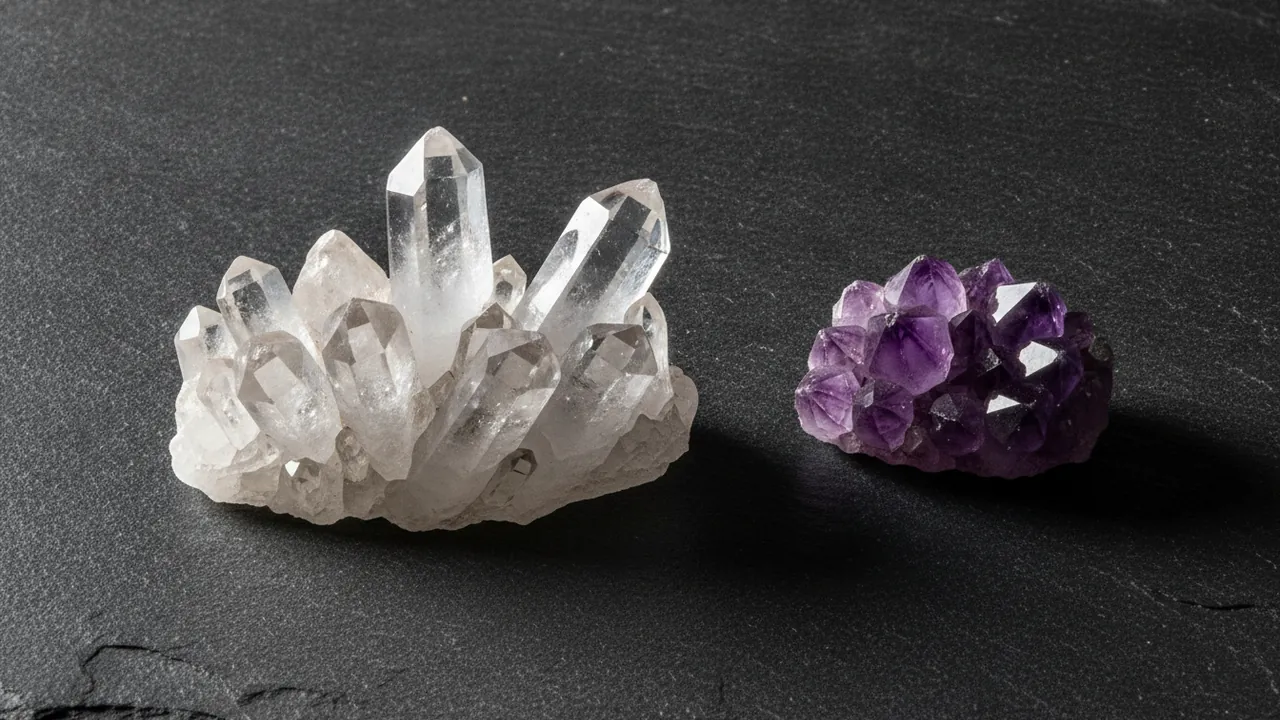
To use a crystal identifier method on a specimen, check four things in order: the shape of the crystal (its habit), how it breaks (cleavage or fracture), how hard it is, and how it shines. Color comes last, because the same mineral can be purple, yellow or clear and different minerals share colors.
How to read a crystal's shape first
Habit is the outward form a crystal grows into: prismatic points, tabular plates, fibrous bundles, round botryoidal bumps, grainy masses or cubes. It hints at the crystal system (there are seven: triclinic, monoclinic, orthorhombic, tetragonal, trigonal, hexagonal and isometric), but habit alone never proves identity. Quartz and calcite are both trigonal, for example, yet they look nothing alike.
Cleavage, hardness and luster of a crystal
- Cleavage is breakage along flat, smooth planes. Calcite splits into slanted blocks, and fluorite splits into octahedral fragments.
- Fracture is breakage that ignores planes. Quartz breaks with curved, shell-like (conchoidal) surfaces.
- Hardness is scratch resistance on the Mohs scale: talc 1, gypsum 2, calcite 3, fluorite 4, apatite 5, orthoclase feldspar 6, quartz 7, topaz 8, corundum 9, diamond 10. A fingernail is about 2 to 2.5, a copper coin about 3 and a steel nail about 5.5.
- Luster is how a fresh surface reflects light: glassy (vitreous), metallic, pearly, resinous, silky, waxy or earthy. Check it on an unweathered face.
Five common crystals and how to separate them
| Mineral | Hardness | What settles it |
|---|---|---|
| Quartz (clear, amethyst, citrine, rose) | 7 | Glassy, six-sided prisms, shell-like fracture, scratches glass |
| Calcite | 3 | Rhombohedral cleavage; fizzes in dilute acid; copper coin scratches it |
| Selenite (gypsum) | 2 | Fingernail scratches it; soft, often in long flat blades or sheets |
| Fluorite | 4 | Perfect octahedral cleavage; steel scratches it easily |
| Pyrite | About 6 to 6.5 | Brassy cubes, striated faces; dark green-black streak; see gold versus pyrite |
The quickest split inside a clear pile is the fingernail test. If it scratches, it is selenite. If a copper coin scratches it and it fizzes, it is calcite. If nothing but a steel file scratches it and the break is curved, it is quartz. Clear quartz with a point at both ends is sold as a Herkimer diamond, and gray-brown quartz is smoky quartz.
Fake, dyed and treated crystals
- Opalite sold in many shops is man-made opalescent glass, not natural opal.
- Aura quartz is real quartz with a thin man-made metallic coating. The rainbow color sits on the surface.
- Dyed agate is real banded chalcedony with added color. Look for dye pooled in cracks.
- Glass and resin can be sold as crystal. Bubbles and mold lines give them away.
Test the piece rather than trusting the shop. For gems that are faceted, the gemstone identifier shows what a loupe adds. Strange green glass sold as a crystal has its own page on moldavite.
Crystals inside geodes and host rocks
A crystal inside a hollow rock is a geode lining, covered in what is a geode. A crystal stuck in a rock you cannot name is easier once you identify the host, which the rock identification steps help with. For comparing a candidate name against photos and descriptions, rockidentifier.io has entries on many common stones. The main rock identifier page shows where every guide on this site fits.
What the evidence says about crystal healing claims
In a 2001 experiment presented to the British Psychological Society, Christopher French and colleagues gave 80 volunteers either real quartz or a fake crystal to hold while they meditated. Reported sensations were similar for both. The study was a conference presentation and was not published in a peer-reviewed journal, so treat it as a small, informative test. It does not support a physical effect beyond expectation. Whatever you feel about crystals, their hardness and cleavage do not change.
Frequently asked questions
How do I identify what crystal I have?
Check habit, cleavage or fracture, hardness and luster, then compare with a mineral reference such as Mindat. A fingernail, coin and steel nail separate selenite, calcite and quartz in under a minute.
How are crystals formed?
Crystals form when atoms lock into a repeating pattern as a melt cools, as a dissolved mineral leaves water, or as vapor condenses. Slow growth in open space gives well-formed faces.
How can I tell if a crystal is fake or dyed?
A fake or dyed crystal shows color pooled in cracks, a surface rainbow that scratches off, bubbles or mold lines, or a hardness that does not fit the claimed mineral.
How can I tell selenite from calcite?
Selenite is gypsum at hardness 2, so a fingernail scratches it. Calcite at hardness 3 resists a nail, yields to a copper coin and fizzes in dilute acid.
Do crystals have healing powers?
No reliable evidence shows crystals treat illness beyond placebo. In a 2001 conference experiment, volunteers holding real and fake quartz reported similar sensations, and the study was never peer reviewed.
What is the difference between cleavage and fracture in a crystal?
Cleavage is breakage along flat, smooth planes, as in calcite. Fracture is breakage that ignores planes, such as the curved, shell-like surfaces of quartz.