
Libyan desert glass: the Sahara's mystery glass
By the AstroStack team · Updated
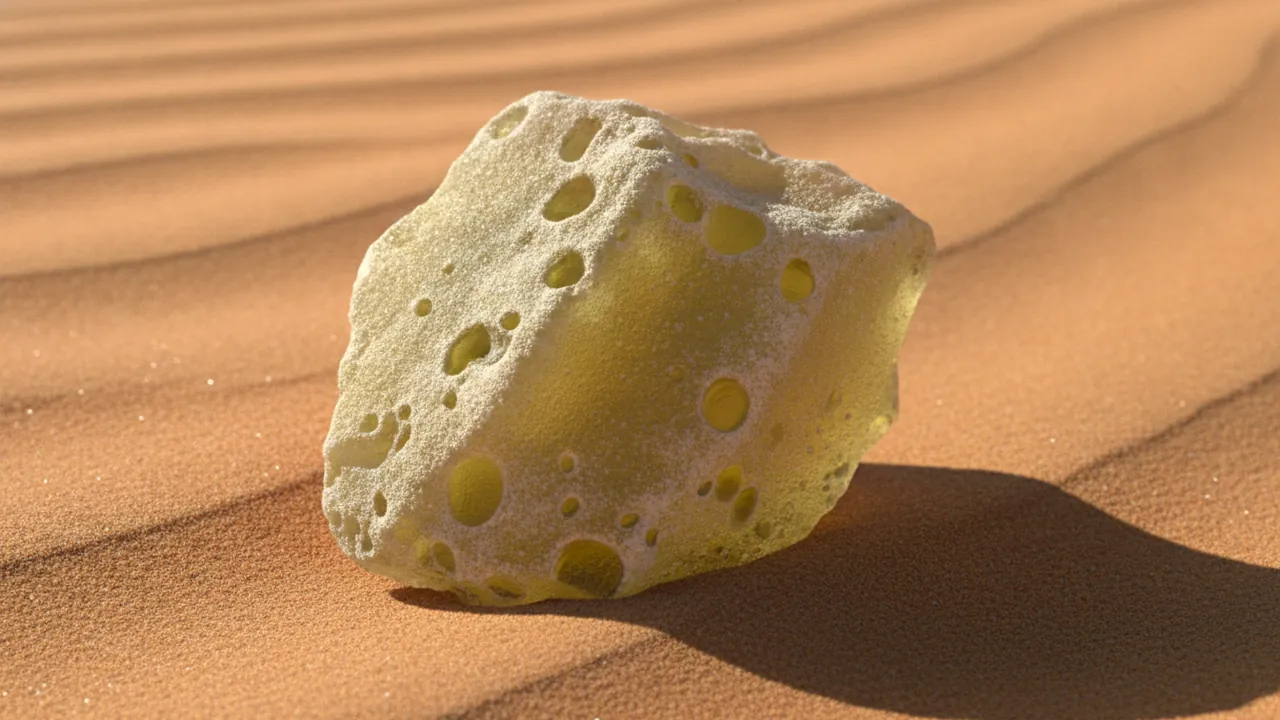
Libyan desert glass is a pale yellow to yellow-green natural glass found in the Great Sand Sea of western Egypt, about 29 million years old and made of nearly pure silica. Most researchers think an impact or an airburst melted desert sand to make it, but nobody has found the crater, so the origin is still argued.
Established facts about Libyan desert glass
- Age. Fission-track dating gives about 28.5 to 29.4 million years, usually rounded to 29.
- Place. Corridors between dunes in the southwestern corner of the Great Sand Sea, close to the Libya-Egypt border.
- Area. About 2,500 square kilometers in peer-reviewed summaries, though larger estimates near 6,500 exist because the field boundary is not standardized.
- Composition. About 96.5 to 99 percent silica, mostly the glass called lechatelierite, which is far purer than a typical tektite.
- Amount. An estimate puts the preserved glass at about 1,400 metric tonnes, and the original mass was probably more.
The Desert named "Libyan" is the northeastern part of the Sahara, so this is Sahara glass in the broad sense. Another glass made by an instant of extreme heat on desert sand, the 1945 atomic test, is covered on trinitite.
Where did Libyan desert glass come from?
Proposals include a hypervelocity impact, an airburst that radiated enough heat to melt the surface, a lightning origin, and even older volcanic ideas. Impact is favored because researchers have found lechatelierite, baddeleyite (a breakdown product of zircon at high temperature), shocked quartz and meteoritic material, but Mindat still records the origin as disputed. Compare that with tektites, whose craters are mostly known: the tektite page covers those, and the meteorite glass overview puts all the candidates side by side.
The Libyan desert glass scarab in Tutankhamun's tomb
A yellow-green glass scarab in the pectoral found in Tutankhamun's tomb is widely identified as Libyan desert glass. It shows that people in Egypt worked and prized the material more than 3,000 years ago. It tells us nothing about the glass's composition beyond that identification, so I will not quote numbers from it.
How to tell real Libyan desert glass from fake
No single feature authenticates a piece, but several together are a good sign.
- Color is pale yellow, honey, yellow-green or slightly milky. A vivid neon "banana" yellow is suspicious.
- Bubbles are irregular or stretched, sometimes in flow streams. Perfect, uniform round bubbles suggest a mold.
- Under strong light, you can see wispy internal flow lines.
- White inclusions of cristobalite and dark wisps support authenticity.
- Surfaces found on the desert floor are wind-abraded and pitted, with a waxy texture. Smooth cast surfaces, mold seams or regular faceting point to imitation.
- Specific gravity is about 2.21, compared with about 2.65 for quartz or citrine, according to one 2026 buying guide. That is only a screening test.
Common substitutes are colored glass and citrine or other quartz. A heavier price makes a lab check worth the cost, and you should demand a provenance record for expensive pieces. The same logic applies to the green cousin of this glass, moldavite, which is faked far more often.
Libyan desert glass prices, checked November 2026
| Piece | Asking price | Source |
|---|---|---|
| 62.6 g | $125 (about $2.00 per gram) | Aerolite Meteorites |
| 190.2 g | $380 (about $2.00 per gram) | Aerolite Meteorites |
| 857.0 g | $2,575 (about $3.00 per gram) | Aerolite Meteorites |
| Small commercial pieces | $5 to $15 per gram | 2026 buying guide from a crystal retailer |
| Gem-grade or large exceptional pieces | $15 to $100 or more per gram | Same guide |
The two sources disagree by a factor of two or three, which is typical for a material sold both as a specimen and as jewelry. Size, clarity, color and shape decide where a piece lands.
Is it legal to export Libyan desert glass?
Dealer sources state that removing the glass from the Egyptian locality is prohibited and that export is restricted under Egyptian and Libyan rules. If you are buying, ask the seller how the piece left the country. The rock identifier hub explains how to test other finds you are unsure about.
Frequently asked questions
How can I tell if Libyan desert glass is real or fake?
Real Libyan desert glass is pale yellow to yellow-green with irregular bubbles, wispy flow lines and a wind-pitted, waxy surface. Neon yellow, perfectly round bubbles and mold seams are warning signs.
Is the Libyan Desert the same as the Sahara Desert?
The Libyan Desert is the northeastern part of the Sahara, covering parts of eastern Libya, southwestern Egypt and northwestern Sudan. The glass is found in the Great Sand Sea in the Egyptian part.
What is special about Libyan desert glass?
Libyan desert glass is nearly pure silica, 96.5 to 99 percent, and has no known source crater. A yellow-green scarab of it sits in Tutankhamun's pectoral.
Is Libyan desert glass rare?
Libyan desert glass is limited, with about 1,400 tonnes estimated in a 2,500 square kilometer area. Dealers still sell it at a few dollars a gram, so it is less rare than moldavite.
Where can Libyan desert glass be found?
Libyan desert glass lies in corridors between dunes in the southwestern Great Sand Sea of western Egypt, near the Libyan border. Collecting is restricted there, so most buyers purchase from dealers.
How old is Libyan desert glass?
Fission-track dating gives Libyan desert glass an age of about 28.5 to 29.4 million years, usually rounded to 29 million.