
What is obsidian, and how is it formed?
By the AstroStack team · Updated
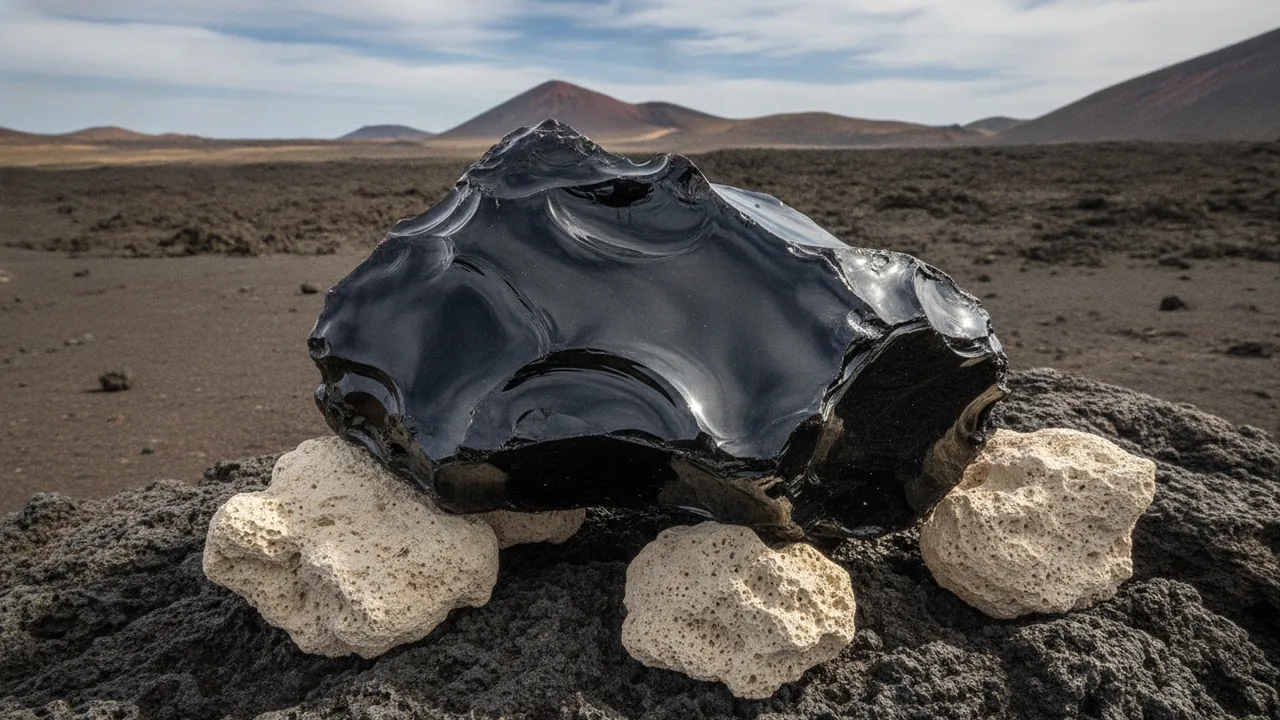
Obsidian is a natural volcanic glass that forms when silica-rich lava, usually rhyolite, cools so fast that crystals have no time to grow. It is black or dark brown, shiny, breaks into razor-sharp curved flakes, and is one of the oldest toolmaking materials people used. (If you searched for the note-taking app, this page is about the rock.)
What obsidian is made of
The USGS describes obsidian as rhyolite magma that cooled rapidly, with silica typically above 74 percent by weight. Because the atoms never organized into a crystal lattice, obsidian is a glass, not a true mineral. Its hardness is about 5 to 5.5 on the Mohs scale, and its density is roughly 2.3 to 2.6 grams per cubic centimeter. Fresh obsidian holds less than 1 percent water. It breaks with a conchoidal fracture, producing smooth, curved, shell-like surfaces with edges thin enough to cut skin without much effort.
How obsidian forms, step by step
Thick, silica-rich lava is sticky. When it reaches the surface and chills quickly, for example at the edge of a flow or where it meets water or ice, atoms freeze in place before they can arrange into crystals. The result is glass with no internal planes, so it breaks into the smooth, curved, razor-edged flakes that early toolmakers used. Pumice is the frothy, bubble-filled cousin, so light that it floats, and both appear in the rock identification chart on the how to identify rocks page. Obsidian does not last forever on geologic timescales: over millions of years glass slowly crystallizes, which is why most obsidian is geologically young.
Colors and varieties of obsidian
- Black is the standard form, colored by tiny iron-bearing particles.
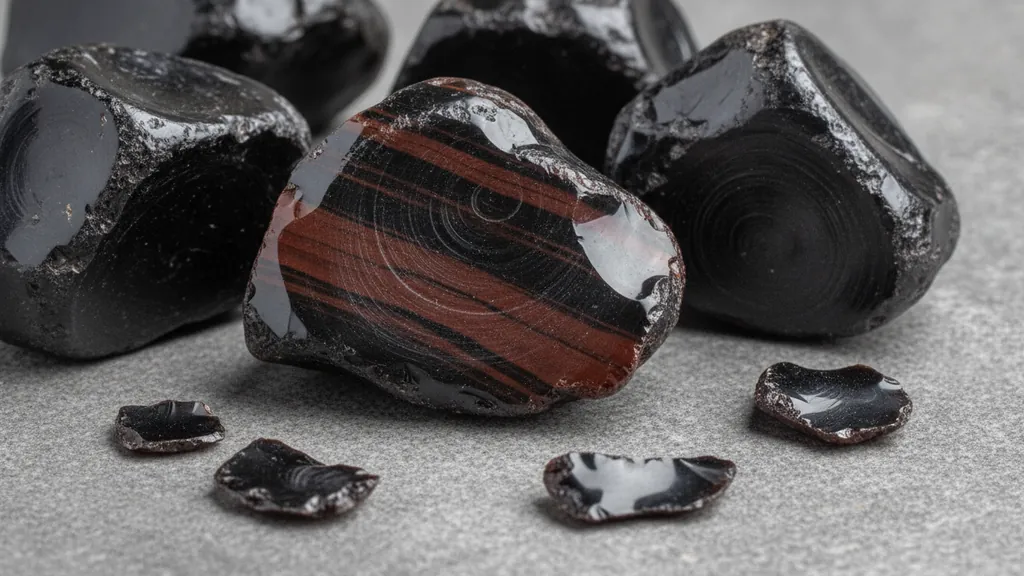
- Mahogany is black with swirls of red-brown, caused by oxidized iron.
- Snowflake obsidian has pale spots of cristobalite, a crystal form of silica, in black glass.
- Rainbow and sheen obsidians show colored bands or a metallic shimmer when turned in light, caused by microscopic layers or inclusions that scatter light.
- Apache tears are small, rounded, translucent nodules, famously collected near Superior, Arizona.
Why people used obsidian for tools
Because it fractures so cleanly, prehistoric people knapped it into arrowheads, spear tips and knives. Yellowstone's Obsidian Cliff is a famous source: the National Park Service records quarrying there for more than 11,000 years, with archaeological evidence of over 50 quarry sites. Obsidian from Yellowstone has been found at distant archaeological sites, which tells researchers about trade routes.
Each lava flow has a slightly different chemical fingerprint, so archaeologists can match a flake to its source flow. They can also estimate how long ago a flake was made: a freshly broken surface slowly absorbs water and builds a microscopic hydrated rind. The thicker the rind, the older the surface, though the rate depends on temperature and glass chemistry and has to be calibrated for each region.
How sharp is obsidian?
A well-knapped obsidian edge has been measured at about 3 nanometers, while a steel surgical scalpel is cited at roughly 300 to 500 nanometers. That is why obsidian blades are used in some experimental surgery and by modern flintknappers. The 3 nm figure is a best case, not a rule: edge quality varies, and obsidian is brittle, so it chips where steel would bend. Wear gloves and eye protection when handling fresh breaks.
How to tell obsidian from other black glass
Look for a conchoidal fracture and flow banding or tiny crystals (the snowflake spots). Natural obsidian is found in or near volcanic terrain, whereas tektites lie in strewn fields with no volcano close by. Bottle glass often has mold seams or perfectly round bubbles. Obsidian that is heated may bubble or froth because of its dissolved water, while tektites, which are nearly dry, do not. For more on the black glass that comes from impacts instead of eruptions, see meteorite glass.
Obsidian compared with look-alike materials
| Material | Where it forms | Hardness | Clue |
|---|---|---|---|
| Obsidian | Volcanic lava that cooled fast | About 5 to 5.5 | Curved fracture; flow banding; found near volcanoes |
| Tektite | Impact melt thrown out of a crater | About 5.5 to 6.5 | Flight-shaped; found in strewn fields away from volcanoes |
| Bottle glass | Man-made | About 5.5 | Round bubbles, mold seams, beach-worn frosting |
| Basalt | Lava that crystallized | Harder than a steel nail in most samples | Dull, not glassy; may hold small holes |
| Jet | Fossilized wood (a coal) | 2.5 to 4 | Warm, light, scratches with a knife; no glassy fracture |
Where obsidian is found in the US
- Glass Mountain, California, is one of the best-known flows in the state.
- Newberry Volcano, Oregon, has the Big Obsidian Flow, about 700 acres of glass.
- Obsidian Cliff, Yellowstone, Wyoming, is the archaeological classic, and off limits to collectors.
- Glass Buttes, Oregon, is a major source on BLM land with several color varieties.
Obsidian prices, checked 2026
Dealer listings in 2026 gave these retail ranges. Raw obsidian ran about $4 to $15 per pound for common black, mahogany, sheen, snowflake, Apache tears and rainbow. Tumbled pieces were about $2 to $20 each, with one mahogany example at $28 per pound. Carved spheres were about $25 to $150, and unusual rainbow or fire pieces $30 to $200 or more. These are asking prices, not appraisals. Plain black rough is cheap; value comes from color, a polish, a sheen that shows and size.
How to clean and store obsidian
Clean it with lukewarm water, mild soap and a soft cloth. Skip ultrasonic and steam cleaners, acids and abrasives, and keep it away from sudden temperature changes. It is glass, so it chips and cracks despite its moderate hardness, and it scratches against harder minerals, so store pieces separately wrapped in cloth. Do not scratch-test a piece you plan to keep.
Can you collect obsidian?
Not everywhere. Taking obsidian from Yellowstone is illegal: NPS regulations (36 CFR 2.1) prohibit possessing, disturbing or removing mineral resources in park units, and Obsidian Cliff is an archaeological and geological resource. Newberry National Volcanic Monument is also a protected area where geological specimens are generally off limits. On BLM land, noncommercial collecting of reasonable amounts is generally allowed where the land is open, as at Glass Buttes, but developed sites, active claims and posted areas are exceptions. Always check with the local office, and leave artifacts, flakes in an archaeological scatter and anything that looks worked where it lies.
To place obsidian among other rocks, the same steps show where glassy igneous rocks sit. Reference entries on common stones are also kept at rockidentifier.io, and the rock identifier home page lists every other guide on this site.
Frequently asked questions
Is obsidian valuable?
Common obsidian is cheap, about $4 to $15 per pound raw in 2026 listings. Carved spheres run about $25 to $150, and rare sheen or rainbow pieces can pass $200.
Is obsidian a rock or a mineral?
Obsidian is a volcanic glass with no crystal structure, so it is not a true mineral. Because it forms from cooled lava, people usually group it with igneous rocks.
Can I collect obsidian at Yellowstone?
No. NPS regulations prohibit removing mineral resources in park units, including loose pieces at Obsidian Cliff, an archaeological site with quarrying more than 11,000 years old.
How sharp is obsidian?
A well-knapped obsidian edge has been measured at about 3 nanometers, against roughly 300 to 500 for a steel scalpel. Obsidian is brittle, so wear gloves.
What is the difference between obsidian and the Obsidian app?
The Obsidian app is note-taking software that shares the rock's name. The rock is volcanic glass, and searches for one often return pages about the other.
How can you tell if obsidian is real?
Real obsidian breaks with curved, shell-like surfaces and razor edges, and shows flow banding or small crystal spots. Bottle glass often has round bubbles and mold seams.
What is obsidian used for?
Early peoples made blades and arrowheads from obsidian, and modern flintknappers still do. Today it is also cut into beads, spheres and cabochons.
What colors does obsidian come in?
Obsidian is usually black, with mahogany (red-brown swirls), snowflake (pale cristobalite spots), and rainbow or sheen varieties. Apache tears are small, rounded, translucent nodules.