
Gemstone identifier: how to tell what your stone is
By the AstroStack team · Updated
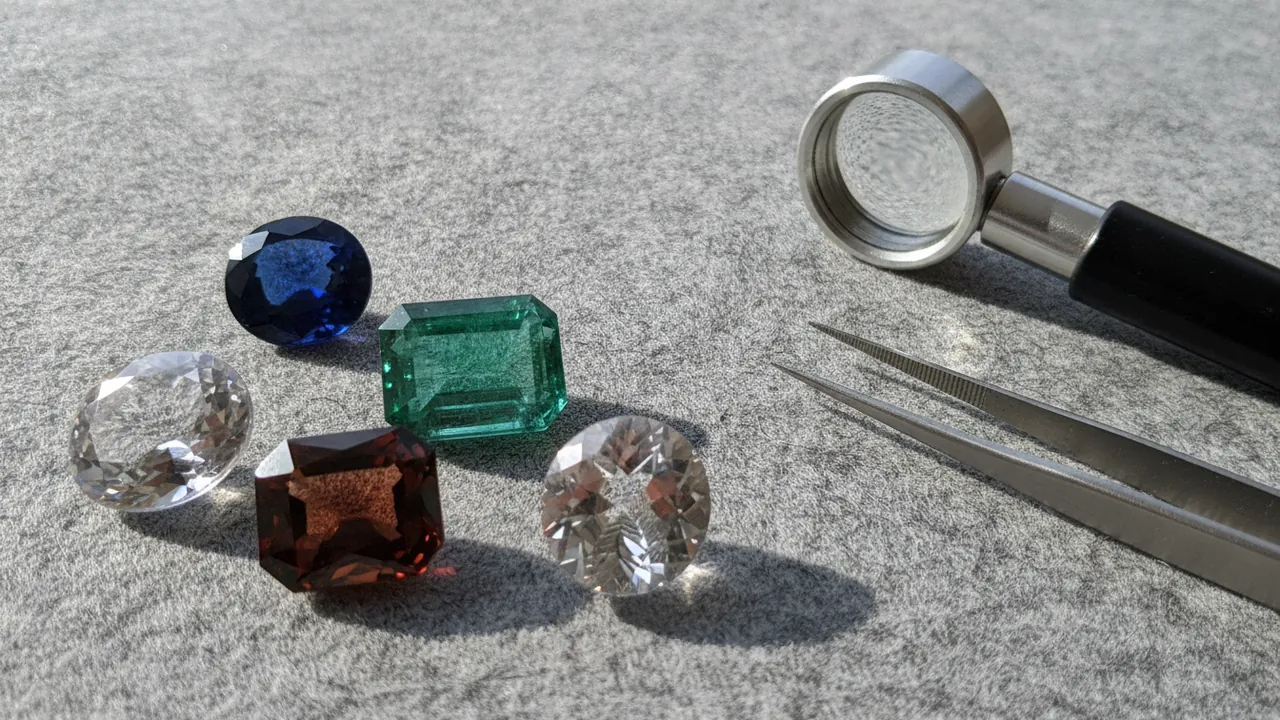
No home gemstone identifier can prove what a stone is. What you can do is rule things out: a 10x loupe, good light and a few careful observations will often show that a stone is glass or a common look-alike, and will tell you when it deserves a gemologist.
Why you should look at a gemstone before scratching it
GIA, the main gem education body, warns that hardness tests can mar or break gems and should not be used on transparent stones. So skip the nail. Hold the stone under a bright lamp and look through a 10x loupe.
- Round or stretched gas bubbles suggest glass. A GIA case study proved a sample was glass by stretched bubbles plus a refractive index near 1.52 and a specific gravity near 2.52.
- Curved color bands or curved growth lines suggest a flame-fusion synthetic ruby, where natural ruby zoning is more angular.
- A straight line at the girdle, with a color change or an interrupted inclusion across it, can mean a doublet, two pieces glued together.
- Mineral crystals, fluid-filled feathers and natural-looking fractures point toward a natural stone, though they are not proof.
Gemstone look-alikes that fool people
| Looks like | Often actually | Clue worth checking |
|---|---|---|
| Diamond | Cubic zirconia | Cubic zirconia is denser than diamond, so a CZ feels heavier for its size; it can show bubbles or a striated look |
| Ruby | Spinel, synthetic ruby, lead-glass filled ruby | Curved striae point to synthetic; flattened bubbles and blue-orange flashes in fractures point to glass filling; spinel needs refractive index and spectrum |
| Emerald | Glass | Spherical or flattened bubbles and flow structure in glass; a lab confirms |
| Any gem | Doublet | Look from the side for a join line and a change in luster |
| Rare green gem | Natural glass such as moldavite | Natural glasses have their own tells; see moldavite |
Mohs hardness values for common gem materials
These values tell you what a stone could be and which gems it can damage in a jewelry box. They are not a test to run on faceted gems. Two quartz varieties are often sold as something grander: the double-ended Herkimer diamond and the brown smoky quartz.
| Material | Mohs hardness |
|---|---|
| Diamond | 10 |
| Corundum (ruby, sapphire) | 9 |
| Topaz | 8 |
| Quartz (amethyst, citrine) | 7 |
| Apatite | 5 |
| Common glass | About 5 to 6 (5.5 is a rough reference) |
A harmless home routine for checking a gemstone
- Clean the stone with a soft cloth so that you are looking at the stone, not the grease on it.
- Record color in daylight and under a lamp. Some stones change in different light.
- Hold the loupe close to your eye and move the stone, not the loupe, until the inside comes into focus. Bubbles sit inside the stone, while dust sits on the surface.
- Look at the girdle and the facet edges. Chipped, worn edges suggest a soft stone, and sharp ones a hard one or a recent cut.
- Compare weight with a stone of the same size. GIA notes that heft can separate materials with very high or very low density, although it takes practice.
- Stop. Anything beyond this needs instruments.
A thermal tester can separate diamond from many simulants, and GIA has documented diamond confirmation by high thermal conductivity together with visual features, not conductivity alone. Treat a tester as a screening step.
Natural, synthetic, treated and imitation gemstones
| Term | Meaning |
|---|---|
| Natural | Formed in the earth with no lab growth |
| Synthetic or lab-grown | Same chemistry as the natural gem, made in a lab |
| Treated | Natural stone changed by heat, filling or other processes |
| Imitation | A different material that looks similar, such as glass for emerald |
| Assembled | Two or more pieces joined, such as a doublet |
Which gemstone checks need a lab
Refractive index, specific gravity, polariscope behavior and spectra are the standard data gemologists use. They need a refractometer and trained interpretation. Take the stone to a GIA-trained gemologist or an accredited gem lab if it might be valuable, if it is mounted, if natural versus lab-grown matters for a sale or insurance, or if your own observations disagree. A home result that fits no reference is "unknown", not a surprise gemstone.
Natural, synthetic, treated and assembled stones are four separate questions. No single visual clue proves a stone is natural, which is why a lab report matters for anything you intend to sell. If your stone is rough and uncut, the rock identification steps may be a better starting point, and for clusters and points the crystal identifier is more useful.
Can a photo identify a gemstone?
A photo can suggest a name for a colorful stone, and sites such as crystalidentifier.net publish crystal and gem references to compare against. A picture cannot show a refractive index or inclusions inside the stone, so keep the lab rule above for anything valuable. For the whole range of what you can find and test, the rock identifier hub lists every guide.
Frequently asked questions
How can I tell if a gem is real or glass?
A 10x loupe shows round or flattened bubbles in glass, while real gems more often show crystals, fluid inclusions or angular zoning. Valuable stones still need a gemologist's measurements.
Should I scratch a gemstone to test it?
No. GIA notes that hardness tests can mar or break gems and should not be used on transparent stones. Use a loupe and a lab instead.
Can I identify a gemstone from a picture?
A picture can suggest candidates by color and form, but it cannot show refractive index, inclusions or treatment. Treat a photo result as a starting point for a loupe check or lab test.
What is the difference between a natural and a lab-grown gemstone?
Lab-grown stones share the chemistry of natural ones, so the difference lies in growth features such as curved striae in flame-fusion ruby. GIA says no single visual clue proves natural origin.
What is called the poor man's diamond?
Cubic zirconia is the stone most often given that nickname, though some people also apply it to moissanite or white sapphire. A gemological test, not the eye, separates them from diamond.
What is a doublet gemstone?
A doublet is two pieces of material glued together to look like one stone. A straight line at the girdle, with a color change or broken inclusion across it, gives it away.