
How to identify rocks, step by step
By the AstroStack team · Updated
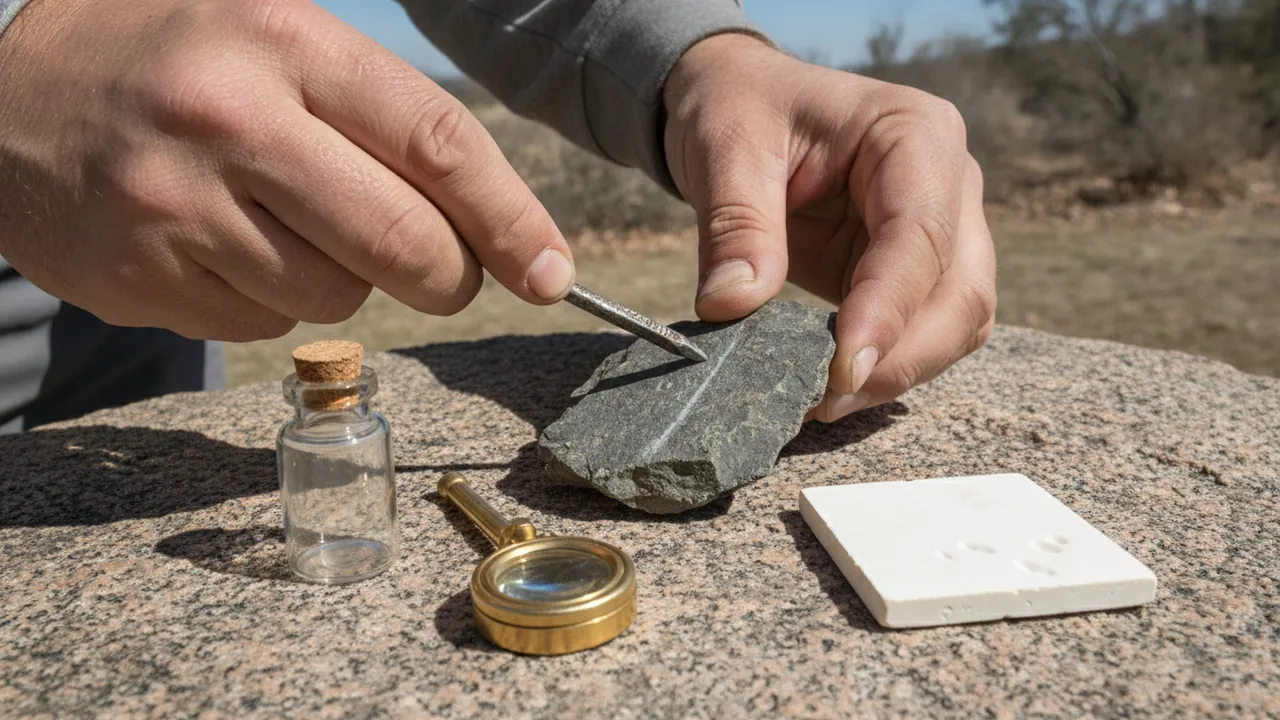
To identify rocks, work out which of three families it belongs to (igneous, sedimentary or metamorphic) by looking at grain size, layers and crystal alignment on a fresh surface, then confirm with simple tests such as hardness and a drop of vinegar. Once you know the family, the name usually takes one more observation.
What you need to identify rocks at home
A 10x hand lens is the best 15 dollars you can spend on this. Beyond that: a steel nail or pocketknife blade (about 5.5 on the Mohs scale), a copper coin (about 3), an unglazed porcelain tile for streak, a small bottle of vinegar and a magnet. Keep a notebook. Write down where the rock came from before you pick up the next one, because location is the clue people forget first.
Step 1: get a fresh surface on the rock
Weathering coats rocks in rust, lichen and a dull skin. Look at a natural break, or wet the surface with water so the grains show. Hammering a rock open is fine on your own land and a bad idea in a park, where collecting is often banned.
Step 2: sort the rock into igneous, sedimentary or metamorphic
- Igneous rocks cooled from melted rock. Slow cooling underground makes visible interlocking crystals (granite). Fast cooling at the surface makes tiny crystals or glass (basalt, obsidian). Round gas holes called vesicles mean lava (pumice, scoria).
- Sedimentary rocks are layers of settled grains or shells cemented together. Look for bedding, rounded sand grains, pebbles in a matrix or fossils (sandstone, shale, limestone, conglomerate).
- Metamorphic rocks were changed by heat and pressure without melting. Aligned minerals or bands are the sign. Gneiss has light and dark stripes, schist sparkles with mica flakes, slate splits into sheets, and marble and quartzite are non-foliated.
The USGS lists phyllite, schist, gneiss, quartzite and marble as the common metamorphic rocks, which is a decent shortlist to carry in your head.
Step 3: run hardness, acid and streak tests on the rock
Testing rock hardness with a nail and a coin
A steel nail is about 5.5 and a copper penny about 3. If the penny scratches your rock, it is softer than 3 (think gypsum or soft limestone). If the nail scratches it but the penny does not, it sits between 3 and 5.5. If the rock scratches the nail, it is harder than 5.5, which points to quartz-rich material. These values are approximate because nails and coins vary.
Testing a rock with vinegar or acid
Put a drop on a fresh surface. Limestone and marble contain calcite and fizz as it releases carbon dioxide. Household vinegar is weak, so a faint or missing reaction does not rule out carbonate; scrape some powder and try again. Keep it off eyes and skin.
Streak and magnet tests for rocks
Rub the sample across unglazed porcelain. Mixed rocks leave a weak or muddy streak, so this test mostly helps with single minerals, and it is the main way to separate gold from pyrite (see how to identify gold in rocks). A magnet that sticks hard means magnetite or metal. A dark, heavy stone that pulls a magnet might be a meteorite, but usually is not; what a meteorite looks like explains how to check.
Rock identification chart
This chart covers the rocks most people actually find. Read it left to right: family, then the clue you can see, then the test that settles it.
| Rock | Family | What you see | Quick test |
|---|---|---|---|
| Granite | Igneous | Visible speckles of pink or white feldspar, glassy quartz and black mica | Scratches a steel nail; no fizz |
| Basalt | Igneous | Dark gray to black, fine grained, sometimes with small holes | Magnet may stick weakly |
| Pumice | Igneous | Pale, full of bubbles, light enough to float | Floats in water |
| Obsidian | Igneous | Black or brown glass, curved shell-like breaks | Sharp edges; see obsidian |
| Sandstone | Sedimentary | Gritty, visible sand grains, often layered | Grains rub off; no fizz |
| Shale | Sedimentary | Dull gray or brown, splits into thin flakes | Smells earthy when wet; soft |
| Limestone | Sedimentary | Fine grained, may hold shells or fossils | Fizzes in vinegar or acid; copper scratches it |
| Conglomerate | Sedimentary | Rounded pebbles set in a sandy cement | Look for rounded, not angular, clasts |
| Gneiss | Metamorphic | Wavy light and dark bands | Banding visible on a fresh break |
| Schist | Metamorphic | Shiny flakes of mica, layered feel | Flakes peel off with a nail |
| Slate | Metamorphic | Smooth, dense, splits into flat sheets | Rings when tapped |
| Marble | Metamorphic | Sugary interlocking crystals, often swirled | Fizzes in acid; copper scratches it |
| Quartzite | Metamorphic | Very hard, glassy broken surface, grains fused | Scratches a steel nail; breaks through grains |
| Quartz | Mineral | Clear to milky, glassy, no flat cleavage | Hardness 7; scratches glass; the brown-gray form is smoky quartz |
| Geode | Rock with cavity | Round, bumpy, lighter than it looks | See geodes |
When a photo helps identify a rock and when it does not
Photos are good for recording scale, color and texture. They cannot measure hardness, streak or density, and the USGS says accurate identification generally needs the rock in your hand. If you do want a second opinion on a hard case, the identifier at rockidentifier.io publishes rock entries and blog posts you can compare against, and AI Rock ID takes a photo on iPhone or Android. Either way, check the name against a test.
What to read after identifying a rock
If your rock turns out to be one single clear or colored mineral, the crystal identifier picks up where this page stops. For the full overview of every kind of find, go back to the rock identifier hub.
Frequently asked questions
What does vinegar do to rocks?
Vinegar fizzes on rocks containing calcite, such as limestone and marble, as the acid releases carbon dioxide. Scrape the rock to a powder if the fizz is faint.
What are the three main types of rock?
The three main rock types are igneous, which cooled from melt, sedimentary, which formed from cemented sediment or shells, and metamorphic, which heat and pressure altered. Granite, sandstone and marble are one example of each.
What characteristics are used to identify a rock?
Geologists look at grain size, texture, color, mineral content, layering or banding, hardness and reactions such as fizzing in acid. Locality also narrows the list before any test.
Is a steel nail a good hardness test?
A steel nail is a rough hardness test at about 5.5 on the Mohs scale, with a copper coin at about 3. Together they split rocks into soft, medium and hard.
Why does the outside of my rock look different from the inside?
Weathering stains and coats a rock's surface with rust, clay or lichen. A fresh break or a wet surface shows the real color and texture.
What is the easiest way to tell granite from basalt?
Granite shows visible speckles of pink or white feldspar, glassy quartz and black mica. Basalt is dark gray to black and fine grained, sometimes with small holes.
How can I tell limestone from sandstone?
Limestone is fine grained, may hold shells or fossils and fizzes in vinegar or acid. Sandstone is gritty with visible sand grains that rub off, and it does not fizz.