
What does a meteorite look like, and how can you tell?
By the AstroStack team · Updated
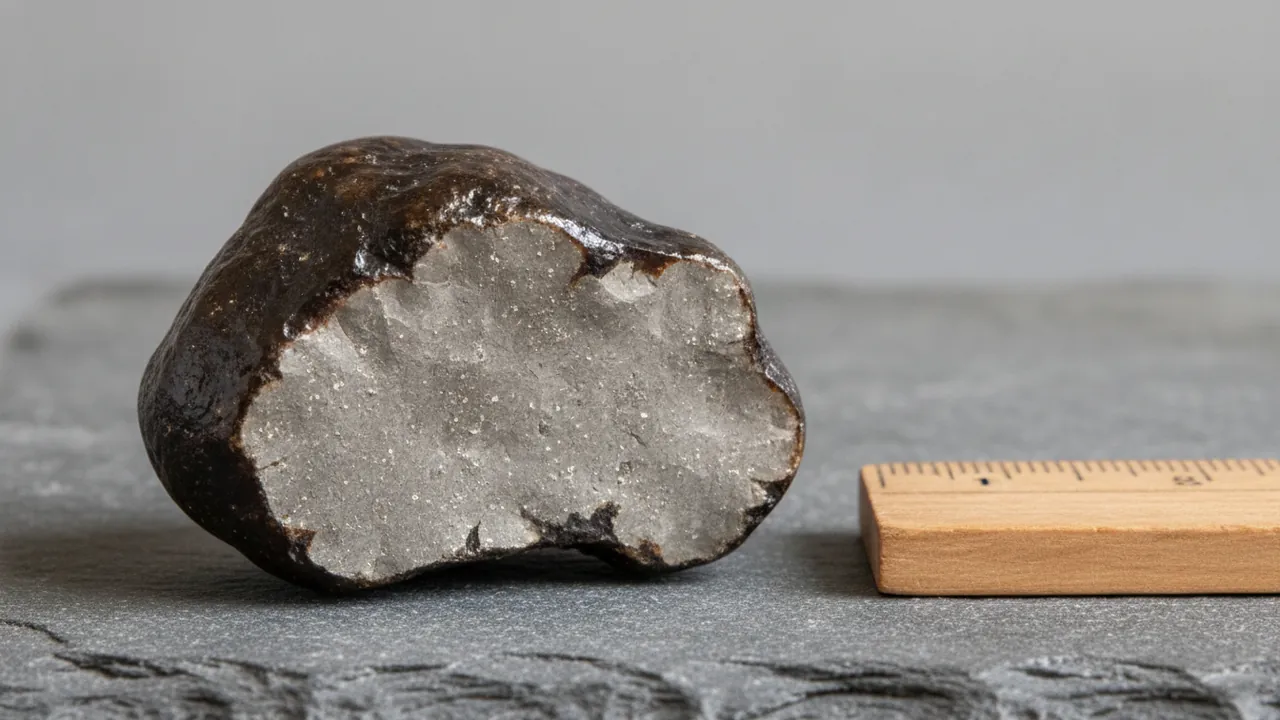
A meteorite usually looks like a dark, heavy, rounded or angular rock with a thin black or brown outer skin, called a fusion crust, and a gray interior speckled with tiny metal flecks. No single sign proves it, so you combine several: the crust, weight, magnetism, a missing streak and the absence of holes.
What the outside of a meteorite looks like
Falling through the atmosphere melts the surface of a stone for a few seconds, leaving a thin, dark, often matte crust. How thick it is varies with the composition and the flight, so there is no safe thickness figure to measure against. Many meteorites also carry shallow thumbprint dents called regmaglypts, made as the surface ablated. Those are suggestive only, because plenty of earthly rocks are pitted too. Rounded edges and an overall compact shape are common, but weathered finds in deserts can be rust brown instead of black.
What the inside of a meteorite looks like
Most meteorites fall into three broad kinds. Stony meteorites are gray inside, often with metal flecks and, in chondrites, small round grains called chondrules a millimeter or so across. Iron meteorites are solid iron-nickel metal, and once cut, polished and etched they show a woven Widmanstatten pattern of kamacite and taenite. Stony-irons mix both, and the showiest of them is the pallasite, with olivine crystals in a metal web.
Chondrites dominate what people actually pick up. Ordinary chondrites make up about 80 to 85 percent of observed falls, depending on whether you use University of Arizona or Smithsonian figures. Irons are a small minority of finds, around 3 percent in one Smithsonian-hosted summary.
Five meteorite tests, and what each one proves
| Test | What a meteorite does | Why it is not proof |
|---|---|---|
| Weight | Stony: about 3.0 to 3.7 g/cm3. Stony-iron: about 4.5 to 5.0. Iron: about 7.0 to 8.0. It feels heavier than a rock its size | Slag and iron-rich rocks are dense too |
| Magnet | Most attract a magnet because of iron-nickel metal; irons strongly, some stones weakly | Magnetite, slag and old iron stick as well |
| Streak | Rubbed on unglazed ceramic, fresh meteorites leave little or no colored streak | Weathered finds can leave a weak brown streak |
| Holes | No bubbles or vesicles | Absence is a good sign; presence is a strong no |
| Nickel | Irons contain roughly 5 to 20 percent nickel | Needs lab analysis; a household nickel kit is not reliable |
To run the streak test, drag a corner of the rock across the bare ceramic ring under a mug or an unglazed tile. Red-brown means hematite. Gray-black means magnetite. Those two are the most common impostors.
What people mistake for meteorites
The collector name for these is meteorwrongs. Slag is glassy, often magnetic and full of bubbles. Magnetite is strongly magnetic with a gray-black streak. Hematite is usually non-magnetic with a red-brown streak. Basalt is dark and dense but often has small holes, and iron-rich concretions can be rounded and heavy. Our guide on how to identify rocks has the hardness and streak routines for sorting these quickly. A glassy black stone found in the right region might be a tektite or other natural glass instead, see meteorite glass. For the types and the terms (meteoroid, meteor, asteroid), see what is a meteorite, and for iron cut into jewelry, meteorite rings.
What to do if your rock passes the meteorite tests
Photograph it where you found it, note the exact location, and do not clean, cut or grind it. Then send a fingernail-sized piece to an expert, not the whole stone. The North Dakota Geological Survey lists the Center for Meteorite Studies at Arizona State University, the University of Minnesota, the University of North Dakota and the Smithsonian's National Museum of Natural History among the places that identify samples. Some labs keep part of a sample for classification, so ask about their terms first. Do not put a price on it until a lab has classified it.
Who owns a meteorite you find
- On private land, a meteorite generally belongs to the landowner, and you need permission to search or remove it.
- On BLM land, casual collection is limited to hand-carried pieces, up to 10 pounds per person per year where the land is open to collecting; science collection needs a permit.
- In national parks casual collecting is not allowed, and the Bureau of Reclamation and Fish and Wildlife Service also prohibit it.
- Meteorites are not minerals under the mining laws, so a mining claim does not give you rights to them.
Rules change, so confirm with the managing office before you collect. For the wider picture of what else turns up on the ground, start at the rock identifier hub.
Frequently asked questions
Is it illegal to own a meteorite?
Owning a meteorite is generally legal in the US, but the find location matters. A meteorite on private land belongs to the landowner, and casual collecting is banned in national parks.
Do meteorites stick to magnets?
Most meteorites attract a magnet because they contain iron-nickel metal. Irons are strongly magnetic and some stony ones only weakly, while magnetite and slag stick too.
Do meteorites leave a streak?
Fresh meteorites leave little or no colored streak on unglazed ceramic. Hematite leaves red-brown and magnetite gray-black, and weathered finds can leave a weak brownish streak.
How do I get a meteorite tested?
Send a fingernail-sized piece with the exact find location to a university or museum expert, such as the Center for Meteorite Studies at Arizona State University.
How much is a meteorite worth?
A meteorite's price depends on type, freshness, size, whether it is cut and polished, and official classification. Unclassified rocks have no market value, so wait for a lab result.
What is a fusion crust on a meteorite?
A fusion crust is the thin, dark, often matte skin formed when the surface of a stone melts during its fall. It is often less than a millimeter thick.