
What is a geode? Formation, identification and how to open one
By the AstroStack team · Updated
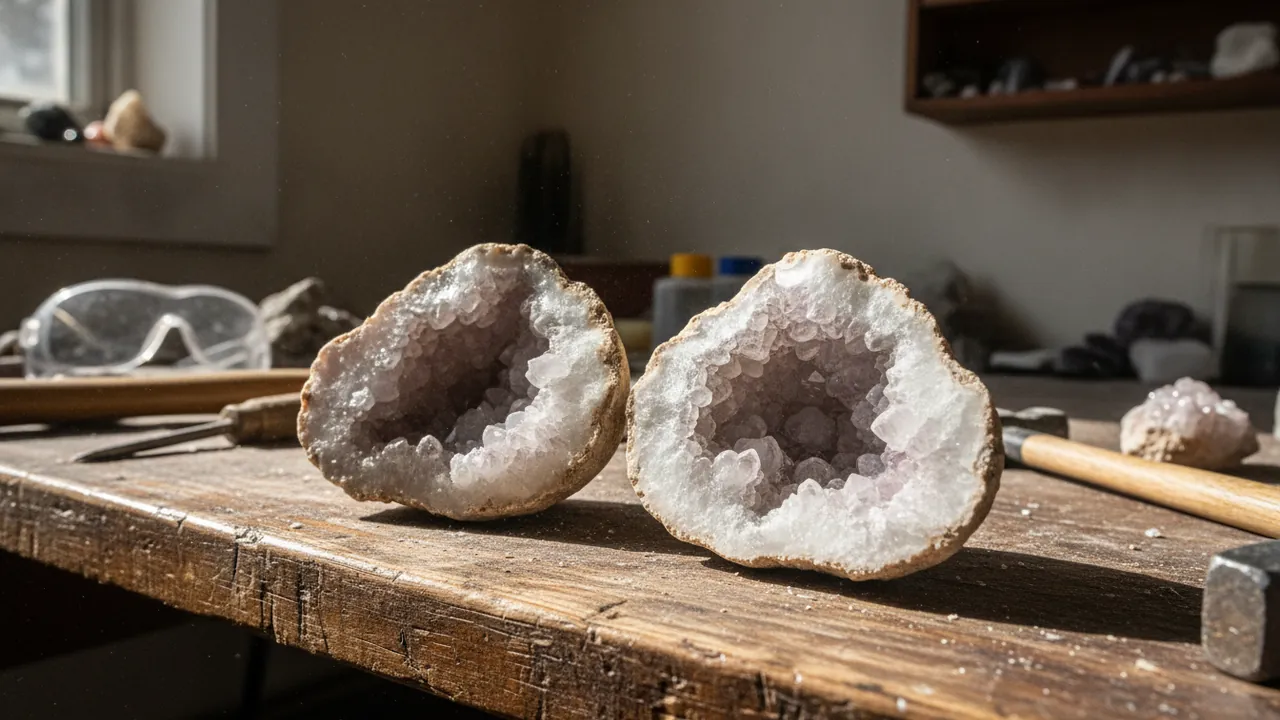
A geode is a rounded, usually hollow rock whose inner cavity is lined with crystals that grew inward from the walls. The outside looks like a plain lumpy stone. The surprise is inside, where quartz, amethyst, calcite or celestite may have crystallized in the open space.
How a geode forms
It starts with a cavity. In volcanic rock the hole is a gas bubble. In limestone it can be a space left where a fossil or other material dissolved. Groundwater carrying dissolved silica, carbonate and other minerals seeps in, and as conditions change, minerals leave the water and grow on the cavity walls. Smithsonian records document quartz and amethyst in volcanic-rock cavities and calcite in limestone ones. The outer shell is often harder than the surrounding rock, which is why geodes weather out and end up loose in a creek bed.
How to tell if a rock is a geode
Nothing is conclusive until you open it, but a few clues add up.
- Shape. A geode tends to be round or egg-shaped, with a bumpy or cauliflower-like surface.
- Weight. It can feel lighter than a solid rock of the same size, because of the empty space. There is no reliable weight cutoff.
- Sound. A gentle tap may sound hollow, but the sound varies with wall thickness.
- Shaking. A little loose material rattling inside is possible, but not required.
- Setting. Limestone beds, creek gravel in the Midwest and volcanic ash beds in the West are common homes.
A solid nodule looks much the same from outside. If it is not a geode, the rock identification steps will help you sort out what you have.
How to crack open a geode safely
- Put on safety glasses and gloves. Rock chips fly.
- Wrap the geode in a towel or put it in a bag, and keep bystanders back.
- For a controlled split, score a line around the middle with a pipe cutter, tightening a little each turn, until it parts.
- Otherwise, tap along a line with a hammer and chisel, set on the ground or a solid surface. Never hold the geode in your hand while striking it.
- Rinse the halves with water and let them dry.
Any method can shatter fragile crystals, and some geodes simply have thick, solid walls. A rock saw gives the cleanest cut but costs more.
Minerals found inside geodes
Quartz, amethyst and calcite are the usual ones, with celestite in some places. The crystal identifier explains how to tell them apart: quartz is hard (7), calcite fizzes in dilute acid, and soft crystals scratch with a nail. Clear double-ended crystals that grew in cavities in New York dolostone are the famous Herkimer diamonds.
What is a geode worth?
| Type | Typical 2026 price |
|---|---|
| Iowa or Keokuk geodes, unopened | About $2 to $5 each |
| Small Iowa halves | About $4 to $7 |
| Attractive Iowa calcite pairs | About $22 to $65 |
| Brazilian amethyst geodes | About $10 to $56 per pound, or $50 to $200 per kilogram in another compilation |
| Mexican crystal geodes (Las Choyas) | About $10 to $40 for a pair |
| Moroccan break-your-own geodes | About $3 to $25 |
Most geodes sell for roughly $2 to $60, and big, fully crystal-lined specimens can reach hundreds or thousands. These are retail asking prices, and size, color, completeness and dyeing change them. Strongly colored blue or green "amethyst" can be dyed.
Gold in geodes
Gold can occur in geodes, but it is rare. Most hold quartz, calcite or chalcedony. A gold-colored rim or coat is far more often paint or iron staining, and a gold claim needs a real test. The test for telling gold from pyrite is on how to identify gold in rocks. If you want to hunt for geodes instead of buying them, where to find geodes lists real US spots, and the photo identifier at airockid.com can give a first name for a crystal you uncover. The rock identifier page links every other guide.
Frequently asked questions
What tools do you need to open a geode?
Opening a geode takes safety glasses, gloves and a towel or bag to contain chips, plus a pipe cutter for a controlled split or a hammer and chisel.
Is gold ever found in geodes?
Gold rarely occurs in geodes, since most hold quartz, calcite or chalcedony. A gold-colored rim is usually paint or iron staining, so test it before assuming.
Is a geode worth anything?
Most geodes sell for a few dollars to about $60. Iowa geodes cost around $2 to $5 unopened, and Brazilian amethyst geodes about $10 to $56 per pound in 2026 listings.
How can you tell if a rock has a geode in it?
A round, bumpy shape, a lighter feel than a solid rock and a hollow sound when tapped are clues. Only breaking or cutting the rock shows the inside.
Why are geodes hollow?
Geodes form around a cavity, such as a gas bubble in volcanic rock or a dissolved fossil in limestone. Mineral-rich water deposits crystals on the walls that only partly fill the space.
Are blue or green geodes dyed?
Strongly colored blue or green geodes sold as amethyst can be dyed. Natural amethyst is purple, and dye often pools in cracks.