
Meteorite rings: how to buy a real one and keep it from rusting
By the AstroStack team · Updated
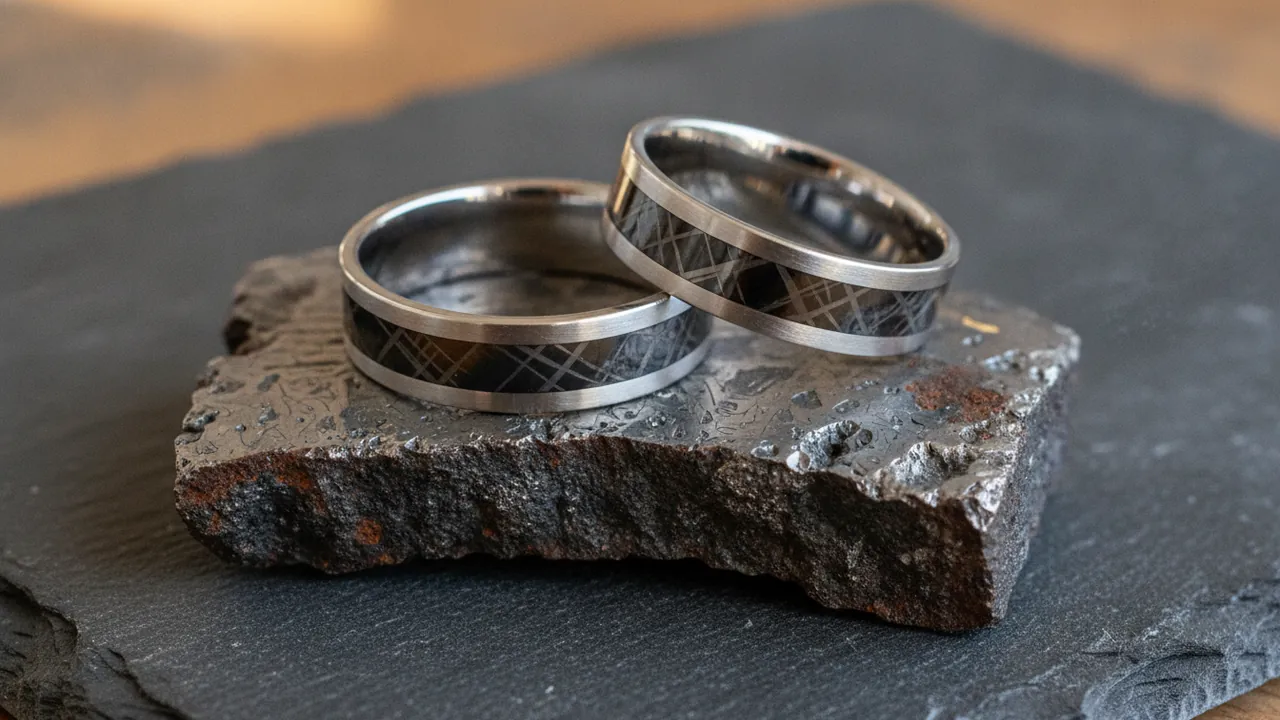
A meteorite ring is a band with a slice or inlay of real iron meteorite, usually Gibeon from Namibia, set in titanium, tungsten carbide or gold. The metal is billions of years old and shows a crisscross crystal pattern when it is etched. Genuine ones start around $80 to $100 and the better ones run from about $300 to $1,200 or more. The main risks are rust and fakes.
What a meteorite ring is made of
The meteorite is nearly always an iron, because iron-nickel metal can be sliced thin, polished and etched. A jeweler cuts a slice, grinds it flat, then etches it with an acid such as ferric chloride so the Widmanstatten pattern appears. The slice is inlaid in a ring of another metal, and sealed to protect it. Three irons turn up most often:
| Meteorite | Where from | Notes for ring buyers |
|---|---|---|
| Gibeon | Namibia, a fine octahedrite | The best known for rings. A strewn field of roughly 390 by 120 km. Namibia made it a national monument in 1975, so new collection and unlicensed export are banned. Rings use material exported earlier |
| Muonionalusta | Northern Sweden | Also cut and etched for its pattern. Jewelry sellers describe it as more rust-prone than Gibeon |
| Campo del Cielo | Argentina | A group of irons sold as slices, beads and jewelry material. Common, and the cheapest of the three |
The pattern is the point. It is the same structure described on the what is a meteorite page, where kamacite and taenite metal crystals grew slowly as an asteroid's core cooled. Factory steel does not cool slowly enough to grow it, so the pattern is the feature that separates real iron meteorite from steel.
How to tell a real meteorite ring from a fake
- Look for a Widmanstatten pattern: interlocking bands and angles, uneven and never repeating exactly. A stamped or printed pattern repeats.
- Check the magnet. Iron meteorites attract it strongly. A weak response is a warning, but a magnet does not prove authenticity, because steel sticks to it too.
- Ask for a named meteorite and find location, such as Gibeon, Namibia. "Meteorite look" or "space metal" with no name is a red flag.
- Ask for independent proof. A certificate from the seller is not verification, while a lab classification or a dealer with a documented chain of custody is.
- Expect the pattern on both faces of a thin slice, but not always: a pattern on both sides supports authenticity but cannot prove it, since polish, coating and ring construction hide it.
Fakes are usually etched or patterned stainless steel, Damascus steel or printed decorative metal. They look right at arm's length, which is why the price tells you something. Genuine meteorite-inlay tungsten rings almost never cost under about $80, according to one 2026 seller, so a $25 "Gibeon" band is steel.
Meteorite ring prices, checked November 2026
| Ring | Material | Price | Seen |
|---|---|---|---|
| Gibeon inlay, "The Thor" (Thorum) | Tungsten carbide | $420 regular, $315 on sale | November 20, 2026 |
| Gibeon inlay, "The Asteroid" (Thorum) | Tungsten carbide | $580 regular, $435 on sale | October 27, 2026 |
| Gibeon inlay, "The Gibeon" (Thorum) | Grade 5 titanium | $850 regular, $638 on sale | June 20, 2026 |
A UK seller in 2026 describes entry-level genuine-inlay rings from about 100 pounds and prominent meteorite rings at roughly 800 to 1,200 pounds. Those are retail listings, not market values, and gold and platinum bands cost far more. The raw material is cheap: Campo del Cielo iron sold for about $0.50 a gram in September 2026, so most of what you pay for is the cutting, etching, setting and the Gibeon name.
Do meteorite rings rust?
Yes, they can. The meteorite is iron and nickel, and water, sweat, salt and chlorine speed up rust. Sealed rings last longer, but the edges and any scratches let moisture in. Some sellers describe Gibeon as comparatively resistant and Muonionalusta as much more prone to rust.
- Take the ring off before swimming, bathing, washing dishes or cleaning with chemicals.
- Avoid chlorine, bleach, acids, salt water and hot tubs.
- Dry it after wearing and keep it in a dry box. A desiccant packet helps.
- Wipe on a light coat of mineral oil or wax now and then to slow moisture.
- If rust appears, have a jeweler clean, polish and re-etch it. Do not use abrasives or harsh chemicals at home.
A green finger is a separate matter. It usually comes from the copper in a ring's base alloy or plating reacting with sweat, not from the meteorite itself.
Who should buy a meteorite ring
Buy a meteorite ring if
- You want a ring with a real story and a pattern no two copies share
- You will take it off for water and chores
- You are buying from a seller who names the meteorite and gives proof
Skip a meteorite ring if
- You work with water, chemicals or sweat all day
- You want a ring that never needs care
- The price seems too low for the metal named
Meteorite is a good choice for a wedding band when it sits in a durable frame such as titanium or tungsten and the pattern is sealed. Compare the pattern itself, not just the name on the box. For the other metal-and-crystal space rock, read about pallasite. If you have a rock you suspect is a meteorite, start with what a meteorite looks like, and the rock identifier home page has the rest of the guides.
Frequently asked questions
How much is a meteorite ring?
Genuine meteorite-inlay tungsten rings rarely cost under about $80, and Gibeon rings in tungsten or titanium were listed at roughly $315 to $850 in 2026. Gold and platinum bands cost much more.
Are meteorite rings worth it?
A meteorite ring suits someone who wants a real piece of an asteroid's core with a pattern no one can copy exactly. The raw metal is cheap, so the price pays for craft and provenance.
How do you clean a meteorite ring?
Wipe a meteorite ring dry with a soft cloth after wearing and avoid soaking it. If rust spots appear, a jeweler can clean, polish and re-etch it.
Is Gibeon meteorite legal to buy?
Yes, from legitimate sellers. Namibia declared the Gibeon field a national monument in 1975 and banned new collection and unlicensed export, but material exported earlier can still be traded.
Do meteorite rings turn your finger green?
A meteorite ring usually does not turn skin green because of the meteorite. Green skin normally comes from copper in a ring's base alloy or plating reacting with sweat.
How can you tell if a meteorite ring is fake?
Look for a Widmanstatten pattern that varies and never repeats, test it with a magnet, and ask for the named meteorite and find location. No single sign proves it.