
Trinitite: atomic glass, how radioactive it is and how to spot fakes
By the AstroStack team · Updated
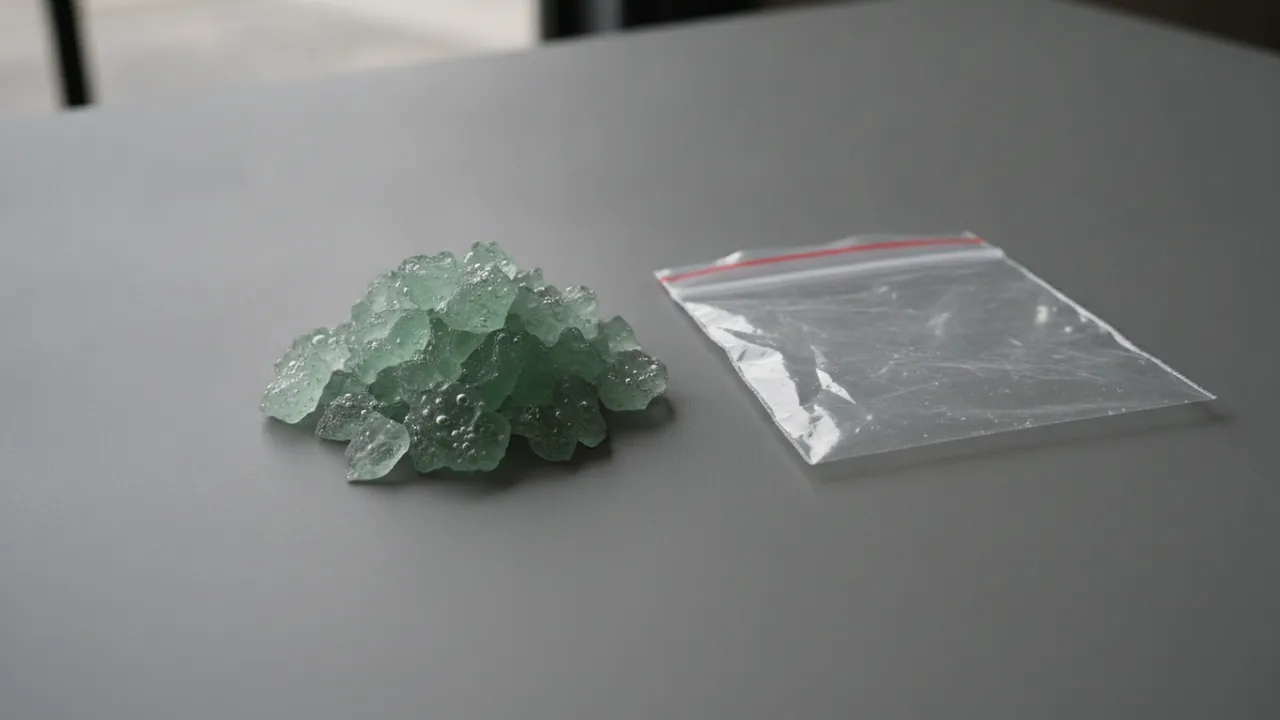
Trinitite is a green, glassy rock made when the first atomic bomb was tested at Trinity Site, New Mexico, on July 16, 1945, and its heat fused the desert sand into glass. It is still mildly radioactive, it is illegal to take new pieces from the site, and the stones that circulate among collectors are old material whose authenticity depends on paperwork.
How trinitite formed at Trinity Site
The test device was fired from a 100-foot tower over arkosic desert sand, a mix of quartz and feldspar. The fireball melted the sand beneath it, drew some of it up into the cloud, and let it fall back as droplets and sheets of glass that cooled on the ground. Most pieces are pale to dark green, thin and glassy, with a rough sandy underside and a smooth, bubbly top. The color is not a sign of radioactivity and does not prove a piece is real.
Some pieces are red, a rarer variety. The red color comes from copper, generally attributed to the copper wiring and instrumentation near the test that vaporized and mixed into the melt. The name was coined from the site: Trinity plus "-ite", the mineral suffix.
A new kind of crystal inside the glass
In 2021 researchers from Italy and the United States, led by Luca Bindi and including Paul Steinhardt and Terry Wallace, reported an icosahedral quasicrystal in a sample of red trinitite. It has the composition Si61Cu30Ca7Fe2 and formed under the extreme pressure and heat of the explosion. It was published in the Proceedings of the National Academy of Sciences, and it was the oldest known human-made quasicrystal at the time. Quasicrystals have an ordered but non-repeating atomic pattern, and finding one in a nuclear test sample showed that these structures can form in violent events, not only in a lab.
Is trinitite radioactive?
Yes, but mildly. The fission and activation products trapped in the glass include americium-241, cesium-137, europium-152 and cobalt-60. The exact mix and activity vary from piece to piece, and a particular piece's dose can only be known by measuring it. A one-hour visit to ground zero has been reported at about 0.5 millirem of exposure, which is small compared with the roughly 300 millirem a person gets each year from natural background.
The risk comes from dust, not from holding an intact piece for a moment. Do not grind, cut, heat or sand trinitite, and do not breathe or swallow dust from it. Keep pieces sealed in a container, plastic or resin, wash your hands after handling and keep them away from children and pets. Dealers often sell pieces encased in clear acrylic for this reason.
A Geiger counter reading shows a piece is radioactive. It does not show that it is trinitite, because background, contamination and instrument sensitivity all vary.
Is it legal to collect or sell trinitite?
Taking trinitite from Trinity Site is prohibited, and it is illegal to remove radioactive material from White Sands Missile Range. The ban has been reported as in force since 1952. The site is on a military range and opens to the public only twice a year, in 2026 on the first Saturday in April and on October 17, with gates open from 8 a.m. to 2 p.m. Visitors can see the monument at ground zero and the remaining small pieces, but they must leave them.
The glass on the market today is old material, collected in the years after the test before the removal ban. Whether a given seller can sell a given piece legally depends on documented provenance and on the shipping rules in your country, since radioactive items are regulated in transit. Ask for the paperwork before you pay.
How to tell if trinitite is real
No visual test proves it. Green glass, slag, furnace products and artificially irradiated glass can all look like trinitite, and the genuine article varies a lot. Better checks are:
- Documented provenance that dates the piece to the years before the ban, with the name of the collector or a collection it came from.
- Natural glass texture with embedded sand grains, bubbles and flow marks, not a uniform factory glass.
- Characteristic radionuclides, identified by gamma spectroscopy, not just a clicking counter.
- Independent testing by a radiation lab when the piece is costly.
Cheap "trinitite" in rock-shop bins with no provenance should be treated as green glass until shown otherwise.
Trinitite prices in 2026
| Seller | Piece | Price | Date |
|---|---|---|---|
| Brooke Alvinston | 2.7 g piece | $36 | April 4, 2026 |
| ScienceMall-USA | 2.6 g piece | $295 | November 20, 2026 |
Two pieces of almost the same weight differ by a factor of eight, and the gap is mostly documentation, certification and seller reputation, not the glass. Treat low prices with caution, and pay more only for a provenance you can read.
Trinitite versus other natural glass
| Glass | What made it | Typical look | Guide |
|---|---|---|---|
| Trinitite | Nuclear explosion fusing sand | Flat, green, glassy, bubbly top | This page |
| Fulgurite | Lightning melting sand | Hollow, branching tube | Fulgurite page |
| Tektite | Meteorite impact melting rock | Flight-shaped pitted glass | Tektites |
| Obsidian | Volcanic eruption | Black, shiny, curved fracture | Obsidian |
Trinitite is closest to fulgurite: both are sand melted by a brief, intense energy burst. The difference is the source, and the radioactivity. The wider family of impact glass is compared in the meteorite glass guide. For the general method of sorting a glassy find, see how to identify rocks, and the rock identifier home page links the rest.
Frequently asked questions
Is it legal to sell trinitite?
Removing trinitite from Trinity Site is illegal, but dealers openly sell pieces that left the site decades ago. Legality turns on documented provenance and your country's shipping rules for radioactive items.
How radioactive is trinitite today?
Trinitite is mildly radioactive, holding americium-241, cesium-137, europium-152 and cobalt-60. A one-hour visit to ground zero is reported at about 0.5 millirem.
Why is it illegal to collect trinitite at Trinity Site?
Trinity Site is on White Sands Missile Range, where removing radioactive material is illegal, and the ban on taking trinitite has been reported as in force since 1952.
Can you still buy trinitite?
Dealers sell trinitite collected after the 1945 test, often sealed in acrylic. Listings seen in 2026 ranged from $36 for a 2.7 g piece to $295 for a 2.6 g piece.
How can you tell if trinitite is real?
No visual test proves trinitite is real. Look for documented provenance, natural glass texture with sand grains and bubbles, and isotopes found by gamma spectroscopy.
What is red trinitite?
Red trinitite is a rarer variety colored by copper, generally attributed to wiring and instruments near the test. A 2021 study found an icosahedral quasicrystal in a red sample.