
Herkimer diamond: the quartz that looks cut and where it comes from
By the AstroStack team · Updated
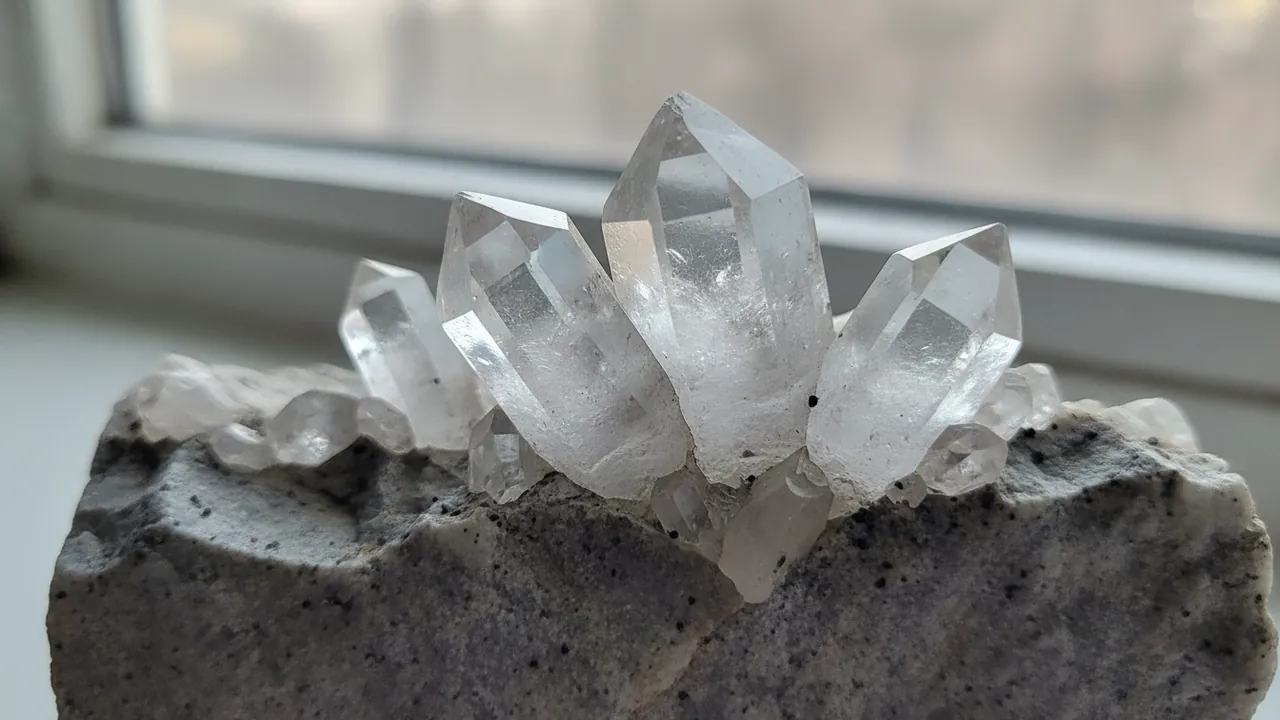
A Herkimer diamond is not a diamond. It is a clear, naturally double-terminated quartz crystal, found in the Little Falls Dolostone around Herkimer County, New York, and prized because its faces are so sharp and bright that it looks cut. It scores about 7 on the Mohs scale, the same as ordinary quartz, and the rock it grows in is roughly 500 million years old.
Why a Herkimer diamond looks cut
Most quartz crystals grow attached to a rock wall and end in a point on one side only. Herkimer crystals grew free inside water-filled pockets, called vugs, in the dolostone, so they developed a termination at both ends. The result is six sides, two pointed ends and eighteen facets in all, with no polishing needed. The crystals are naturally very clear, and some hold tiny bubbles of water or black flecks of anthraxolite, a hydrocarbon related to coal.
The host rock formed about 500 million years ago in the Cambrian, but the quartz itself grew later, and the exact age is not pinned down. The type area is Herkimer County, especially around Middleville and Little Falls, and similar crystals are sold as Herkimer-type from nearby Fulton and Montgomery counties in New York, and from Afghanistan, Norway and China. Looks alike does not mean grew alike, so the name "Herkimer" properly belongs to the New York material.
Herkimer diamond versus real diamond and glass
| Trait | Herkimer diamond | Real diamond | Glass imitation |
|---|---|---|---|
| Material | Quartz (SiO2) | Carbon | Man-made glass |
| Hardness | 7 | 10 | About 5.5 |
| Shape | Six-sided, double-terminated, natural faces | Octahedral rough, or cut | Molded or cut, no crystal form |
| Fracture | Conchoidal, no cleavage | Cleavage in four directions | Conchoidal |
| Specific gravity | About 2.65 | About 3.5 | About 2.4 to 2.6 |
| Sparkle | Glassy, bright | Intense fire | Glassy or dull |
The two are easy to separate with a hardness test: a diamond scratches everything, while quartz scratches only softer stones. For a general method that works on any clear crystal, the crystal identifier guide covers shape, break and hardness.
How to tell a real Herkimer diamond from glass
- Check the shape. Natural Herkimer quartz has six-sided prism geometry and two terminations. Glass usually has no crystal faces.
- Try a scratch on glass, on a spot you do not mind. Quartz scratches window glass, and window glass does not scratch quartz. It is a screening test only, because some glass is hard, and it can mark the specimen.
- Look inside. Natural pieces show fractures, anthraxolite specks and sometimes fluid inclusions. Molded glass shows round bubbles or flow lines, or none at all.
- Weigh it. Quartz has a specific gravity near 2.65, but glass overlaps that range, so weight does not settle it.
- For a stone that matters, a gem lab can check the optics. Quartz is birefringent, and ordinary glass is not.
A water bubble in the crystal is supportive, not proof. Provenance helps more: sellers who say the mine or county, show the actual piece and take returns are the safer buy. The same logic applies to smoky quartz and other quartz sold by the kilo.
Where to dig Herkimer diamonds in New York
You can dig them yourself in Herkimer County, where the crystals are mined from the dolostone and weathered out of loose rubble. The Herkimer Diamond Mines KOA charges admission for mining: $19 for ages 13 and up and $16 for ages 5 to 12 on the 2026 page seen in June, free for under five, with a $3 weekend surcharge for adults and $2 for children. Ace of Diamonds, the other commercial mine in the district, was reported closed until further notice in late 2026, so confirm before you drive. Bring a hammer, a chisel, safety glasses and gloves, and expect to split rock for most of the day.
Crystals run from microscopic to roughly 10 cm, and the common finds are pea-sized. Because they formed in vugs, a pocket often holds several. That vug origin is the same story as a geode: a hollow in rock that fills with crystals from water. For the hunt, the where to find geodes page lists other US digging sites.
What a Herkimer diamond is worth
Most are inexpensive. Market guides in 2026 put small rough crystals of about half a carat to three carats at roughly $15 to $50 per carat, with retail pieces from a few dollars up, and large, flawless crystals with no damage at far higher prices. These are guide estimates, not dealer listings. Value rises with size, clarity, completeness of both terminations, fewer chips and unusual inclusions, such as an enhydro with a moving bubble or a crystal with an anthraxolite phantom.
So any claim that a Herkimer diamond is a rare, valuable gem is a sales line. They are lovely, inexpensive crystals. The cut-and-polished versions in jewelry are just quartz, and prices for them follow the setting more than the stone. The same is true of most quartz, as the gemstone identifier explains.
How to clean and store a Herkimer diamond
Rinse it in lukewarm water with a drop of mild soap and a soft brush, then dry it. Because the crystals are brittle at the points, avoid knocks, especially on the terminations. Skip ultrasonic and steam cleaners if there are fractures or fluid inclusions, since heat and vibration can extend a crack. Store crystals apart from harder stones, and keep sharp points from scratching other jewelry. In a ring, take it off before using hand sanitizer or cleaning chemicals.
Do Herkimer diamonds have metaphysical powers?
Many shops attribute energy or healing properties to these crystals. There is no scientific evidence for that, and the effects people report are explained by expectation, a point that applies to every crystal sold this way. If you want a Herkimer diamond because it is a striking natural crystal, that is reason enough. More reference entries live at crystalidentifier.net, and the rock identifier home page links to every other guide here.
Frequently asked questions
Are Herkimer diamonds real diamonds?
No. A Herkimer diamond is quartz (silicon dioxide) with hardness 7, while diamond is carbon at hardness 10. The name comes from the sparkle and faceted shape of crystals from Herkimer County, New York.
What is special about a Herkimer diamond?
A Herkimer diamond is double-terminated, with a point at both ends and eighteen natural facets. It grew free in water-filled pockets in 500-million-year-old dolostone, so it never needed cutting.
Are Herkimer diamonds worth anything?
Herkimer diamonds are worth little. Market guides in 2026 put small rough crystals at roughly $15 to $50 per carat, and only large, clear, undamaged pieces cost far more.
Can you dig Herkimer diamonds yourself?
The Herkimer Diamond Mines KOA lets visitors dig for an admission fee, $19 for ages 13 and up on its 2026 page, with a weekend surcharge for adults.
How old are Herkimer diamonds?
The Little Falls Dolostone that holds Herkimer diamonds formed about 500 million years ago in the Cambrian. The quartz grew in the rock later, and its exact age has not been fixed.
Is it a Herkimer diamond or just clear quartz?
A true Herkimer diamond is double-terminated with sharp natural facets and comes from the New York district. Similar crystals from Afghanistan, Norway or China are sold as Herkimer-type.
How do you clean a Herkimer diamond?
Rinse a Herkimer diamond in lukewarm water with a drop of mild soap and a soft brush, then dry it. Skip ultrasonic and steam cleaners if the crystal has fractures or fluid inclusions.