
Smoky quartz: why it is brown, how to spot fakes and what it costs
By the AstroStack team · Updated
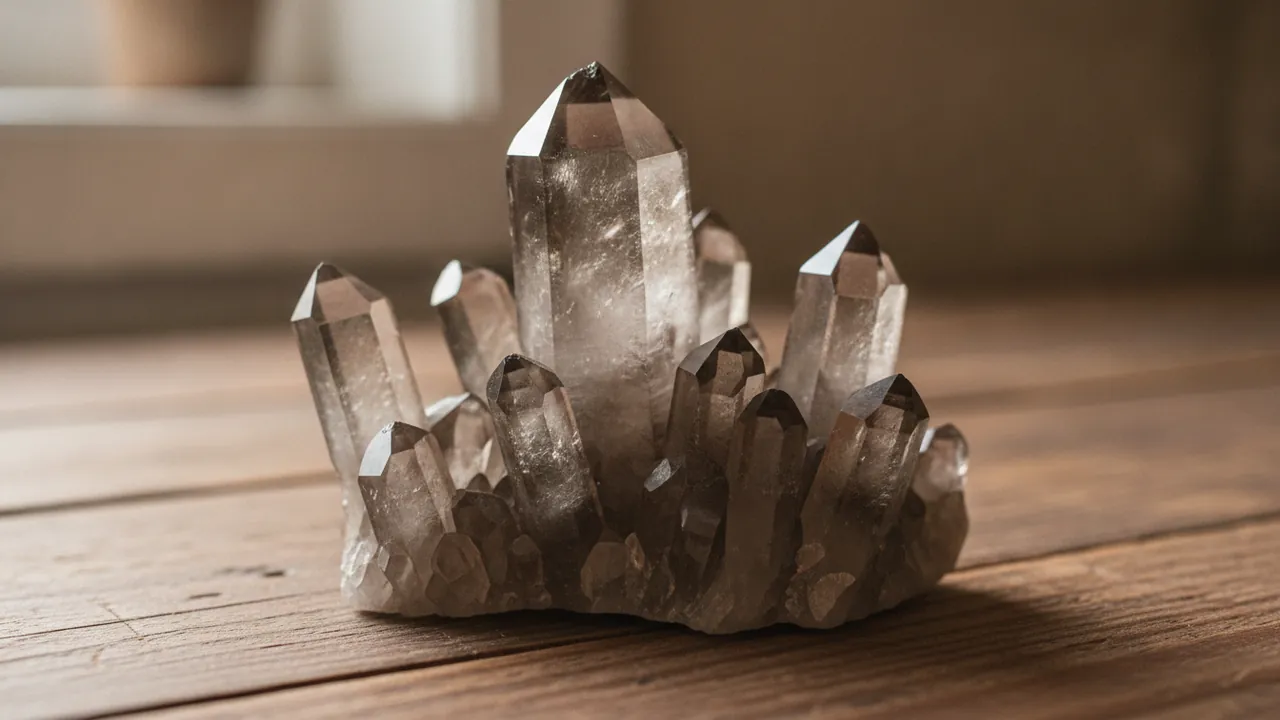
Smoky quartz is quartz that has turned gray, brown or nearly black because natural radiation has acted on tiny amounts of aluminum in the crystal. It has the same chemistry (silicon dioxide) and the same Mohs hardness (7) as clear quartz, and it is one of the most common and affordable crystals sold. The darkest, almost opaque kind is called morion.
Where the color comes from
Pure quartz is colorless. In smoky quartz, some aluminum atoms sit in place of silicon in the crystal, and natural radiation from the surrounding rock knocks electrons loose, creating color centers that absorb light. The longer and stronger the radiation, the darker the stone. That is why smoky quartz is common in granite and pegmatites, which carry small amounts of radioactive elements, and rare in places without them. The crystal itself is not radioactive. The radiation did its work earlier, over a long time.
The color can be taken back out. Heating smoky quartz can fade the color and may turn it yellow or orange, the way much of the citrine in crystal shops is made. Strong sunlight and heat over time can also fade lighter stones.
Smoky quartz properties at a glance
| Property | Smoky quartz |
|---|---|
| Formula | SiO2 |
| Crystal system | Trigonal, six-sided prisms with pointed ends |
| Hardness | 7 on the Mohs scale, scratches glass and steel |
| Color | Light gray-brown to black (morion); yellow-brown in the Cairngorm variety |
| Break | Conchoidal, no cleavage |
| Color cause | Natural irradiation of aluminum-bearing quartz |
Where smoky quartz is found
- Colorado, USA: the Pikes Peak granite area, Lake George and Crystal Peak, and Mount Antero in Chaffee County, where it grows with aquamarine and other pegmatite minerals.
- Scotland: the Cairngorms give the variety called cairngorm, a yellow-to-brown smoky quartz long used in Highland jewelry. Cairngorm is traditionally called Scotland's national gem, though no law makes it official.
- Brazil, Switzerland and Madagascar are also reported sources for commercial crystals.
Colorado's official state gemstone is aquamarine, not smoky quartz, although the state is famous for smoky crystal. Good collecting areas around Pikes Peak and Mount Antero overlap with mining claims, so you need the claim owner's permission on those. Small-scale personal collecting may be allowed on some open National Forest and BLM land, but the rules vary by district and by land status, so check with the local office first. The same advice applies to every dig, as covered on where to find geodes.
How to tell real smoky quartz from fake
Three things are sold as smoky quartz: natural crystals, colorless quartz that has been irradiated to make it dark, and dyed quartz or glass. Treated stone is the hard case, because laboratory irradiation produces the same color centers as nature, and only a gem lab report can separate them.
- Natural color is spread through the crystal and often shows zoning, with darker bands near the tip or the core.
- Dye collects in cracks and at drill holes.
- Glass has round bubbles, no crystal faces and a hardness near 5.5. Quartz scratches window glass and glass does not scratch quartz.
- A perfectly uniform dark color in a rough clear crystal, at a very low price, usually points to treatment.
Irradiated quartz is still real quartz, and many people are happy with it. The issue is disclosure: a seller should say if the color was produced in a lab.
Smoky quartz versus other brown and gray stones
| Stone | What it is | How to separate it |
|---|---|---|
| Smoky quartz | Quartz, hardness 7 | Transparent to translucent, glassy, crystal points, scratches glass |
| Citrine | Yellow to orange quartz | Same hardness and shape, but yellow or orange, and often heat-treated amethyst or smoky quartz |
| Obsidian | Volcanic glass | No crystal faces, hardness about 5; see obsidian |
| Smoky topaz | Aluminum silicate | Heavier, harder (8), cleaves in one direction; much more costly |
| Brown glass | Man-made | Bubbles, mold seams, softer than quartz |
The break is the quickest field check: quartz fractures in curved, shell-like surfaces, and calcite, which is sometimes mistaken for it, is much softer and fizzes in vinegar. The tests are laid out in how to identify rocks, and clear Herkimer-type material is covered on Herkimer diamond.
What smoky quartz costs, checked November 2026
| Form | Listing | Price |
|---|---|---|
| Rough, 1 kg lot | Amezoni Crystals, November 22, 2026 | $89 per kg |
| Cluster, 5.65 kg | Amezoni Crystals, November 22, 2026 | $490 total, about $87 per kg |
| Selected pieces, 9 in a 1 kg lot | Amezoni Crystals, November 22, 2026 | $360 per kg |
| Faceted cabochons, 124 carats | Amezoni Crystals, November 22, 2026 | $136 for 8 pieces, about $1.10 per carat |
These are one dealer's asking prices on one day. Ordinary rough is inexpensive, and prices climb with transparency, size, termination, locality and lack of damage. A common rough kilo for under $100 answers the usual "how much is a kilogram of quartz worth" question for this variety. Clear, large, well-formed crystals from known localities are the ones that command more.
How to clean and store smoky quartz
Clean it with lukewarm water, mild soap and a soft brush. Avoid steam and ultrasonic cleaners, harsh chemicals and sudden temperature changes. Keep it out of long, direct sunlight and away from heat sources, because the color centers that make it smoky can fade. Quartz scratches materials softer than 7, so store it apart from opals, pearls and other soft stones, though it can still chip on impact.
What smoky quartz is used for
Practically, it makes good beads, cabochons, carvings and cabinet specimens, and it takes a good polish. Crystal sellers also attach protective and grounding properties to it. There is no scientific evidence for that, and the effects people report match expectation. A smoky quartz point is a handsome mineral on its own terms. If you would like help narrowing down a dark crystal in a drawer, start with the gemstone identifier, check the broader tests on crystal identifier, or go to the rock identifier home page.
Frequently asked questions
How can you tell if smoky quartz is real?
Real smoky quartz has crystal faces, hardness 7 and color spread through the crystal, often zoned. Dye collects in cracks, and glass shows round bubbles. Only a lab separates natural color from irradiation.
What rock is mistaken for quartz?
Calcite, glass and feldspar are common mix-ups. Quartz has hardness 7, scratches glass and steel, breaks in curved shell-like surfaces and does not fizz in vinegar.
How much is a kilogram of smoky quartz worth?
One dealer listed a 1 kg lot of rough smoky quartz for $89 on November 22, 2026, and a 5.65 kg cluster for $490. Clear, well-formed crystals cost more.
Does smoky quartz fade in the sun?
Smoky quartz can fade if left in long direct sunlight or heat, and heating can turn it yellow or orange. Heating is also how some citrine is made.
What is the difference between smoky quartz and morion?
Morion is the darkest smoky quartz, nearly black and often opaque. Ordinary smoky quartz is lighter, gray to brown, and transparent to translucent.
Is smoky quartz rare?
Smoky quartz is not rare. It is one of the more common colored quartz varieties, especially in granite regions such as Colorado's Pikes Peak area and the Scottish Cairngorms.